Login functionality is undergoing maintenance. If you encounter problems while ordering, please contact us at BDBCustomerService@bd.com.
See More





Login functionality is undergoing maintenance. If you encounter problems while ordering, please contact us at BDBCustomerService@bd.com.
See More

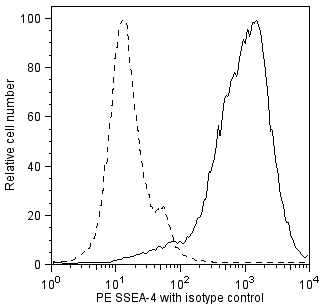
Flow cytometric analysis of PE Mouse Anti-SSEA-4 on H9 cells. H9 human embryonic stem (ES) cells were stained with either PE Mouse Anti-SSEA-4 (solid line) or PE mouse IgG3 (A112-3) isotype control (catalog number 559926, dashed line), incubated in the dark for 20 minutes at room temperature and analyzed by flow cytometry. Flow cytometry was performed on a BD FACSCalibur™ System.
Flow cytometric analysis of PE Mouse Anti-SSEA-4 on H9 cells. H9 human embryonic stem (ES) cells were stained with either PE Mouse Anti-SSEA-4 (solid line) or PE mouse IgG3 (A112-3) isotype control (catalog number 559926, dashed line), incubated in the dark for 20 minutes at room temperature and analyzed by flow cytometry. Flow cytometry was performed on a BD FACSCalibur™ System.


The MC813-70 monoclonal antibody reacts with Stage-Specific Embryonic Antigen-4 (SSEA-4), a carbohydrate epitope on the major ganglioside, but not the neutral glycolipid, of human teratocarcinoma cells. As its name implies, the expression of SSEA-4 is stage-specific and can be used to characterize embryonic cells and monitor their differentiation. However, its expression pattern differs in the human and mouse. In the human, SSEA-4 is found on teratocarcinoma (embryonal carcinoma or EC), embryonic inner cell mass (ICM), embryonic stem (ES) cells, and the K562 erythromyeloid leukeumia cell line. As human stem cells undergo differentiation, SSEA-4 expression is lost. In the mouse, SSEA-4 is found on oocytes and early cleavage-stage embryos, and primitive ectoderm, but not on EC, ICM, or ES cells. In some cases, SSEA-4 expression appears upon differentiation of mouse EC or ES cells.
Please refer to Support Documents for Quality Certificates
Global - Refer to manufacturer's instructions for use and related User Manuals and Technical data sheets before using this products as described
Comparisons, where applicable, are made against older BD Technology, manual methods or are general performance claims. Comparisons are not made against non-BD technologies, unless otherwise noted.
For Research Use Only. Not for use in diagnostic or therapeutic procedures.