







Preparation And Storage


Recommended Assay Procedures
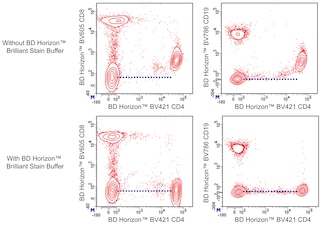
For optimal and reproducible results, BD Horizon Brilliant Stain Buffer should be used anytime two or more BD Horizon Brilliant dyes (including BD OptiBuild Brilliant reagents) are used in the same experiment. Fluorescent dye interactions may cause staining artifacts which may affect data interpretation. The BD Horizon Brilliant Stain Buffer was designed to minimize these interactions. More information can be found in the Technical Data Sheet of the BD Horizon Brilliant Stain Buffer (Cat. No. 563794).
Product Notices
- This antibody was developed for use in flow cytometry.
- The production process underwent stringent testing and validation to assure that it generates a high-quality conjugate with consistent performance and specific binding activity. However, verification testing has not been performed on all conjugate lots.
- Researchers should determine the optimal concentration of this reagent for their individual applications.
- An isotype control should be used at the same concentration as the antibody of interest.
- Caution: Sodium azide yields highly toxic hydrazoic acid under acidic conditions. Dilute azide compounds in running water before discarding to avoid accumulation of potentially explosive deposits in plumbing.
- For fluorochrome spectra and suitable instrument settings, please refer to our Multicolor Flow Cytometry web page at www.bdbiosciences.com/colors.
- Please refer to www.bdbiosciences.com/us/s/resources for technical protocols.
- BD Horizon Brilliant Stain Buffer is covered by one or more of the following US patents: 8,110,673; 8,158,444; 8,575,303; 8,354,239.
- BD Horizon Brilliant Violet 510 is covered by one or more of the following US patents: 8,575,303; 8,354,239.
Companion Products
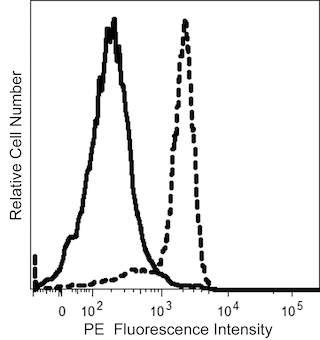
The L25 monoclonal antibody specifically recognizes CD49d which is also known as Integrin alpha-4 (α4 Integrin) or the alpha chain of the Very-Late Antigen-4 (VLA-4α). CD49d is a ~150 kDa type I transmembrane glycoprotein that is encoded by ITGA4 and belongs to the integrin family of cell adhesion molecules. VLA-4, like other integrins, is a noncovalently associated heterodimeric glycoprotein composed of α and β subunits and is involved in cell-cell and cell-extracellular matrix interactions. The β chain of the VLA-4 complex is the CD29 antigen, a 130 kDa glycoprotein. The CD29 antigen, also known as the β1 subunit, is common to the VLA family of integrins. When acting as a matrix receptor, the CD49d antigen binds to CS-1, an alternatively spliced domain of fibronectin. When functioning as a cell receptor, the CD49d antigen binds to the vascular cell-adhesion molecule-1 (VCAM-1). The interaction between the CD49d antigen and VCAM-1 is known to play an important role in stabilizing the adhesion of lymphocytes to endothelial cells and in mediating B-lymphocyte precursor/bone marrow stromal cell adhesion. The CD49d antigen, when associated with the β7 integrin, forms the α4/β7 integrin lymphocyte homing receptor for Peyer's patches, binding to the mucosal vascular addressin MAdCAM-1. The CD49d antigen is also involved in CD3-dependent CD4+ T-lymphocyte activation via its interaction with fibronectin. The CD49d antigen is primarily expressed on T and B lymphocytes and weakly expressed on monocytes. The L25 antibody can block or enhance fibronectin-stimulated T-lymphocyte proliferation. It immunoprecipitates three proteins of 150 kDa, 85 kDa, and 75 kDa under both reducing and nonreducing conditions from HPB-ALL cells, B lymphoblasts, peripheral blood lymphocytes, and IL-2-dependent cell lines.
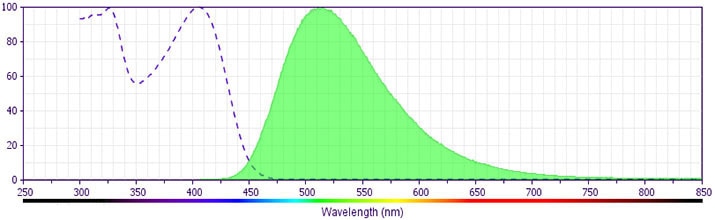
The antibody was conjugated to BD Horizon™ BV510 which is part of the BD Horizon Brilliant™ Violet family of dyes. With an Ex Max of 405-nm and Em Max at 510-nm, BD Horizon BV510 can be excited by the violet laser and detected in the BD Horizon V500 (525/50-nm) filter set. BD Horizon BV510 conjugates are useful for the detection of dim markers off the violet laser.
Development References (22)
-
Albelda SM, Buck CA. Integrins and other cell adhesion molecules.. FASEB J. 1990; 4(11):2868-80. (Biology). View Reference
-
Berlin C, Berg EL, Briskin MJ, et al. Alpha 4 beta 7 integrin mediates lymphocyte binding to the mucosal vascular addressin MAdCAM-1. Cell. 1993; 74(1):185-195. (Biology). View Reference
-
Clayberger C, Krensky AM, McIntyre BW, et al. Identification and characterization of two novel lymphocyte function-associated antigens, L24 and L25.. J Immunol. 1987; 138(5):1510-4. (Immunogen: Flow cytometry, Functional assay, Immunoprecipitation, Inhibition, Radioimmunoassay). View Reference
-
Davis LS, Oppenheimer-Marks N, Bednarczyk JL, McIntyre BW, Lipsky PE. Fibronectin promotes proliferation of naive and memory T cells by signaling through both the VLA-4 and VLA-5 integrin molecules.. J Immunol. 1990; 145(3):785-93. (Biology). View Reference
-
Dittel BN, McCarthy JB, Wayner EA, LeBien TW. Regulation of human B-cell precursor adhesion to bone marrow stromal cells by cytokines that exert opposing effects on the expression of vascular cell adhesion molecule-1 (VCAM-1).. Blood. 1993; 81(9):2272-82. (Biology). View Reference
-
Elices MJ, Osborn L, Takada Y, et al. VCAM-1 on activated endothelium interacts with the leukocyte integrin VLA-4 at a site distinct from the VLA-4/fibronectin binding site.. Cell. 1990; 60(4):577-84. (Biology). View Reference
-
Hemler ME, Kawaguchi S, Bodorova J. CD49b cluster repoty. In: Schlossman SF. Stuart F. Schlossman .. et al., ed. Leucocyte typing V : white cell differentiation antigens : proceedings of the fifth international workshop and conference held in Boston, USA, 3-7 November, 1993. Oxford: Oxford University Press; 1995:1615-1616.
-
Lin Y, Kirby JA, Browell DA, et al. Renal allograft rejection: expression and function of VCAM-1 on tubular epithelial cells.. Clin Exp Immunol. 1993; 92(1):145-51. (Biology). View Reference
-
Maino VC, Picker LJ. Identification of functional subsets by flow cytometry: intracellular detection of cytokine expression.. Cytometry. 1998; 34(5):207-15. (Biology). View Reference
-
Maino VC. Rapid assessment of antigen induced cytokine expression in memory T cells by flow cytometry.. Vet Immunol Immunopathol. 1998; 63(1-2):199-207. (Biology). View Reference
-
Modderman PW. CD29/CDw49, CD47, CD51, CD55, and CD61. In: Knapp W. W. Knapp .. et al., ed. Leucocyte typing IV : white cell differentiation antigens. Oxford New York: Oxford University Press; 1989:1017-1019.
-
Nojima Y, Humphries MJ, Mould AP, et al. VLA-4 mediates CD3-dependent CD4+ T cell activation via the CS1 alternatively spliced domain of fibronectin.. J Exp Med. 1990; 172(4):1185-92. (Biology). View Reference
-
Pitcher CJ, Quittner C, Peterson DM, et al. HIV-1-specific CD4+ T cells are detectable in most individuals with active HIV-1 infection, but decline with prolonged viral suppression.. Nat Med. 1999; 5(5):518-25. (Biology). View Reference
-
Rice GE, Bevilacqua MP. An inducible endothelial cell surface glycoprotein mediates melanoma adhesion. Science. 1989; 246(4935):1303-1306. (Biology). View Reference
-
Rotteveel FT, Kokkelink I, van Lier RA, et al. Clonal analysis of functionally distinct human CD4+ T cell subsets. J Exp Med. 1988; 168(5):1659-1673. (Biology). View Reference
-
Shimizu Y, Newman W, Gopal TV, et al. Four molecular pathways of T cell adhesion to endothelial cells: roles of LFA-1, VCAM-1, and ELAM-1 and changes in pathway hierarchy under different activation conditions.. J Cell Biol. 1991; 113(5):1203-12. (Biology). View Reference
-
Shimizu Y, van Seventer GA, Horgan KJ, Shaw S. Costimulation of proliferative responses of resting CD4+ T cells by the interaction of VLA-4 and VLA-5 with fibronectin or VLA-6 with laminin.. J Immunol. 1990; 145(1):59-67. (Biology). View Reference
-
Springer TA. Adhesion receptors of the immune system. Nature. 1990; 346(6283):425-434. (Biology). View Reference
-
Suni MA, Picker LJ, Maino VC. Detection of antigen-specific T cell cytokine expression in whole blood by flow cytometry.. J Immunol Methods. 1998; 212(1):89-98. (Biology). View Reference
-
Taichman DB, Cybulsky MI, Djaffar I, et al. Tumor cell surface alpha 4 beta 1 integrin mediates adhesion to vascular endothelium: demonstration of an interaction with the N-terminal domains of INCAM-110/VCAM-1. Cell Regul. 1991; 2(5):347-355. (Biology). View Reference
-
Udagawa T, McIntyre BW. A VLA-4 alpha-chain specific monoclonal antibody enhances CD3-induced IL-2/IL-2 receptor-dependent T-cell proliferation.. Lymphokine Cytokine Res. 1992; 11(5):193-9. (Biology). View Reference
-
Waldrop SL, Davis KA, Maino VC, Picker LJ. Normal human CD4+ memory T cells display broad heterogeneity in their activation threshold for cytokine synthesis.. J Immunol. 1998; 161(10):5284-95. (Biology). View Reference
Please refer to Support Documents for Quality Certificates
Global - Refer to manufacturer's instructions for use and related User Manuals and Technical data sheets before using this products as described
Comparisons, where applicable, are made against older BD Technology, manual methods or are general performance claims. Comparisons are not made against non-BD technologies, unless otherwise noted.
For Research Use Only. Not for use in diagnostic or therapeutic procedures.
