







Preparation And Storage


Recommended Assay Procedures
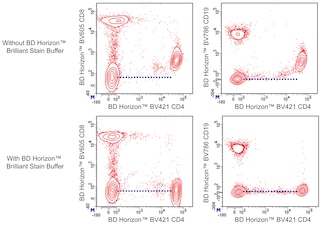
For optimal and reproducible results, BD Horizon Brilliant Stain Buffer should be used anytime two or more BD Horizon Brilliant dyes are used in the same experiment. Fluorescent dye interactions may cause staining artifacts which may affect data interpretation. The BD Horizon Brilliant Stain Buffer was designed to minimize these interactions. More information can be found in the Technical Data Sheet of the BD Horizon Brilliant Stain Buffer (Cat. No. 563794).
Product Notices
- This reagent has been pre-diluted for use at the recommended Volume per Test. We typically use 1 × 10^6 cells in a 100-µl experimental sample (a test).
- Source of all serum proteins is from USDA inspected abattoirs located in the United States.
- An isotype control should be used at the same concentration as the antibody of interest.
- Caution: Sodium azide yields highly toxic hydrazoic acid under acidic conditions. Dilute azide compounds in running water before discarding to avoid accumulation of potentially explosive deposits in plumbing.
- For fluorochrome spectra and suitable instrument settings, please refer to our Multicolor Flow Cytometry web page at www.bdbiosciences.com/colors.
- Pacific Blue™ is a trademark of Molecular Probes, Inc., Eugene, OR.
- BD Horizon Brilliant Violet 421 is covered by one or more of the following US patents: 8,158,444; 8,362,193; 8,575,303; 8,354,239.
- BD Horizon Brilliant Stain Buffer is covered by one or more of the following US patents: 8,110,673; 8,158,444; 8,575,303; 8,354,239.
- Please refer to www.bdbiosciences.com/us/s/resources for technical protocols.
Companion Products
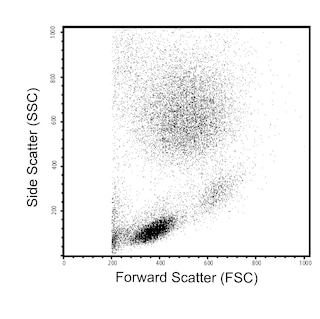

The monoclonal antibody 150503 specifically binds to the human CC chemokine receptor, CCR7, also known as CD197. CCR7 (previously known as BLR2, EBI1 and CMKBR7), a seven-transmembrane, G-protein-coupled receptor, is the specific receptor for CC chemokines, MIP-3β/Exodus 3/ELC/ CCL19 and 6Ckine/Exodus 2/SLC/TCA4/CCL21. CCR7 mRNA is expressed mainly in lymphoid tissues including the spleen, lymph nodes and tonsil. CD197/CCR7 is expressed on peripheral T and B lymphocytes by bone marrow and cord blood CD34-positive cells and by mature dendritic cells. In response to its cognate chemokines, CD197/CCR7 mediates homing of leucocytes to secondary lymphoid tissues. Differential CCR7 expression can be used to distinguish naive, central memory, and effector memory T cell subsets. The human CCR7 gene, unlike other CC chemokine receptor genes, has been mapped to chromosome 17 (region 17q12).
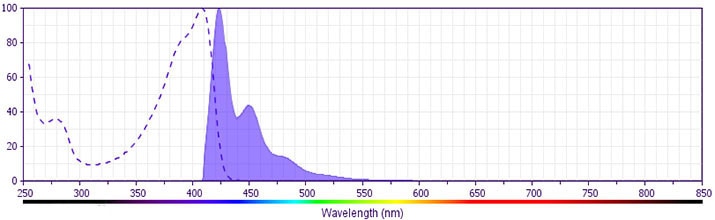
The antibody was conjugated to BD Horizon™ BV421 which is part of the BD Horizon Brilliant™ Violet family of dyes. With an Ex Max of 407-nm and Em Max at 421-nm, BD Horizon™ BV421 can be excited by the violet laser and detected in the standard Pacific Blue™ filter set (eg, 450/50-nm filter). BD Horizon™ BV421 conjugates are very bright, often exhibiting a 10 fold improvement in brightness compared to Pacific Blue™ conjugates.
Caution: Under some complex multi-color conditions, this clone may non-specifically interact with antibodies conjugated with APC-H7 or APC-Cy7, contributing to staining artifacts. BD Horizon Brilliant™ Stain Buffer (Cat. No. 563794), designed to minimize on non-specific fluorescent dye interactions, does not resolve this interaction with either APC-H7 or APC-Cy7. For optimal multicolor staining results, alternatives to APC-H7 and APC-Cy7 should be evaluated.
Development References (8)
-
Birkenbach M, Josefsen K, Yalamanchili R, Lenoir G, Kieff E. Epstein-Barr virus-induced genes: first lymphocyte-specific G protein-coupled peptide receptors. Nature. 1993; 67(4):2209-2220. (Biology). View Reference
-
Burgstahler R, Kempkes B, Steube K, Lipp M. Expression of the chemokine receptor BLR2/EBI1 is specifically transactivated by Epstein-Barr virus nuclear antigen 2. Biochem Biophys Res Commun. 1995; 215(2):737-743. (Biology). View Reference
-
Kim CH, Pelus LM, White JR, Broxmeyer HE. Macrophage-inflammatory protein-3 beta/EBI1-ligand chemokine/CK beta-11, a CC chemokine, is a chemoattractant with a specificity for macrophage progenitors among myeloid progenitor cells. J Immunol. 1998; 161(5):2580-2585. (Biology). View Reference
-
Schweickart VL, Raport CJ, Godiska R, et al. Cloning of human and mouse EBI1, a lymphoid-specific G-protein-coupled receptor encoded on human chromosome 17q12-q21.2. Genomics. 1994; 23(3):643-650. (Biology). View Reference
-
Yanagihara S, Komura E, Nagafune J, Watarai H, Yamaguchi Y. EBI1/CCR7 is a new member of dendritic cell chemokine receptor that is up-regulated upon maturation. J Immunol. 1998; 161(6):3096-3102. (Biology). View Reference
-
Yoshida R, Imai T, Hieshima K, et al. Molecular cloning of a novel human CC chemokine EBI1-ligand chemokine that is a specific functional ligand for EBI1, CCR7. J Biol Chem. 1997; 272(21):13803-13809. (Biology). View Reference
-
Yoshida R, Nagira M, Imai T, et al. EBI1-ligand chemokine (ELC) attracts a broad spectrum of lymphocytes: activated T cells strongly up-regulate CCR7 and efficiently migrate toward ELC. Int Immunol. 1998; 10(7):901-910. (Biology). View Reference
-
Yoshida R, Nagira M, Kitaura M, Imagawa N, Imai T, Yoshie O. Secondary lymphoid-tissue chemokine is a functional ligand for the CC chemokine receptor CCR7. J Biol Chem. 1998; 273(12):7118-7122. (Biology). View Reference
Please refer to Support Documents for Quality Certificates
Global - Refer to manufacturer's instructions for use and related User Manuals and Technical data sheets before using this products as described
Comparisons, where applicable, are made against older BD Technology, manual methods or are general performance claims. Comparisons are not made against non-BD technologies, unless otherwise noted.
For Research Use Only. Not for use in diagnostic or therapeutic procedures.
