The site is undergoing maintenance on
Friday, September 11, 2:00 am through Saturday, September 12, 2:00 am (CEST), 2026.
If you encounter problems while ordering, please contact us at BDBCustomerService@bd.com
See More
The site is undergoing maintenance on
Friday, September 11, 2:00 am through Saturday, September 12, 2:00 am (CEST), 2026.
If you encounter problems while ordering, please contact us at BDBCustomerService@bd.com
See MoreThe site is undergoing maintenance on
Friday, September 11, 2:00 am through Saturday, September 12, 2:00 am (CEST), 2026
.If you encounter problems while ordering, please contact us at BDBCustomerService@bd.com
This page has been recently translated and is available in French now.
Looks like you're visiting us from {countryName}.
Would you like to stay on the current location site or be switched to your location?
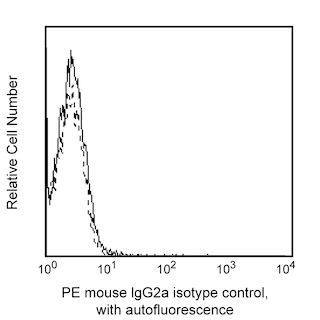
Flow cytometric analysis of CD184 expression on human peripheral blood lymphocytes. Whole blood was stained with either PE Mouse IgG2a, κ Isotype Control (Cat. No. 555574; dashed line histogram) or PE Mouse Anti-Human CD184 (Cat. No. 555974/561733/557145; solid line histogram). Erythrocytes were lysed with BD Pharm Lyse™ Lysing Buffer (Cat. No. 555899). Fluorescent histograms were derived from gated events with the side and forward light-scattering characteristics of viable lymphocytes.
Any use of products other than the permitted use without the express written authorization of Becton, Dickinson and Company is strictly prohibited.
Flow cytometry: Chemokine receptors are known to internalize during manipulation resulting in low frequency expression. Investigators are
advised to perform immunophenotyping studies of chemokine receptors on freshly collected samples (<24 Hrs). Incubation with the antibody
should be done at 4°C in the dark. Cellular manipulation, such as Ficoll separation, freezing, or exposure to cold temperatures prior to staining
should be minimized and have been shown to cause a decrease in staining intensity and/or inconsistent results.
Investigators should note that alternative staining procedures may be neccessary. A multiple-step staining procedure is strongly recommended, in
some instances, to amplify immunofluorescent signals for the flow cytometric analysis of human CXCR4 expression. Investigators may find the
Purified Mouse Anti-Human CD184 antibody (Cat. No. 555972) to be useful in conjunction with appropriate secondary and tertiary reagents for
detecting low frequency expression, such as with Biotin Goat Anti-Mouse Ig (Cat. No. 553999) and PE Streptavidin (Cat. No. 554061).
The 12G5 monoclonal antibody specifically binds to CD184, also known as CXCR4 and Fusin. CD184/CXCR4 is a seven-transmembrane domain, G-protein-linked, glycoprotein chemokine receptor. CD184 serves as a receptor for the C-X-C chemokine, SDF-1. It is expressed on a wide variety of hematopoietic cells including lymphoid and myeloid precursor cells, megakaryocytes, platelets, T and B lymphocytes, granulocytes, monocytes/macrophages, and dendritic cells. It is also expressed on vascular endothelial cells, epithelial cells, neurons and astrocytes. CD184 plays a variety of roles in hematopoiesis, vascularization and neural development. CD184 also functions as a coreceptor for infection with T-cell tropic strains of HIV-1 and as a receptor for CD4-independent infection by some HIV isolates. The 12G5 antibody has been reported to block CD4-independent infection by HIV-2 and CD4-dependent infection by some T-cell tropic isolates of HIV-1.
Please refer to Support Documents for Quality Certificates
Global - Refer to manufacturer's instructions for use and related User Manuals and Technical data sheets before using this products as described
Comparisons, where applicable, are made against older BD Technology, manual methods or are general performance claims. Comparisons are not made against non-BD technologies, unless otherwise noted.
For Research Use Only. Not for use in diagnostic or therapeutic procedures.