The site is undergoing maintenance on
Friday, September 11, 2:00 am through Saturday, September 12, 2:00 am (CEST), 2026.
If you encounter problems while ordering, please contact us at BDBCustomerService@bd.com
See More
The site is undergoing maintenance on
Friday, September 11, 2:00 am through Saturday, September 12, 2:00 am (CEST), 2026.
If you encounter problems while ordering, please contact us at BDBCustomerService@bd.com
See MoreThe site is undergoing maintenance on
Friday, September 11, 2:00 am through Saturday, September 12, 2:00 am (CEST), 2026
.If you encounter problems while ordering, please contact us at BDBCustomerService@bd.com
This page has been recently translated and is available in French now.
Looks like you're visiting us from {countryName}.
Would you like to stay on the current location site or be switched to your location?
Any use of products other than the permitted use without the express written authorization of Becton, Dickinson and Company is strictly prohibited.
BD™ CompBeads can be used as surrogates to assess fluorescence spillover (Compensation). When fluorochrome conjugated antibodies are bound to CompBeads, they have spectral properties very similar to cells. However, for some fluorochromes there can be small differences in spectral emissions compared to cells, resulting in spillover values that differ when compared to biological controls. It is strongly recommended that when using a reagent for the first time, users compare the spillover on cells and CompBead to ensure that BD Comp beads are appropriate for your specific cellular application.
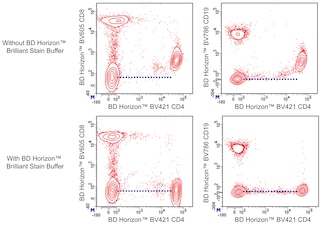
For optimal and reproducible results, BD Horizon Brilliant Stain Buffer should be used anytime two or more BD Horizon Brilliant dyes are used in the same experiment. Fluorescent dye interactions may cause staining artifacts which may affect data interpretation. The BD Horizon Brilliant Stain Buffer was designed to minimize these interactions. More information can be found in the Technical Data Sheet of the BD Horizon Brilliant Stain Buffer (Cat. No. 563794/566349) or the BD Horizon Brilliant Stain Buffer Plus (Cat. No. 566385).
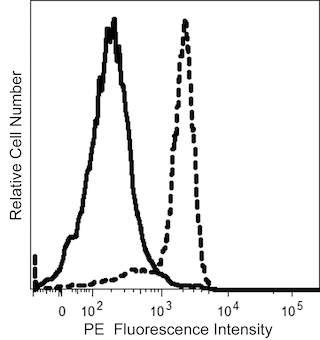
The 5D3/CD338 monoclonal antibody specifically binds to an epitope of ABCG2 (BCRP1), a multi-drug resistance protein that is a member of ATP binding cassette (ABC) transporters. It is highly expressed on primitive stem cells as identified by the "side-population" (SP) phenotype. This SP phenotype is based on the efflux of fluorescent dyes such as Rhodamine 123 and Hoechst 33342. The expression of ABCG2 appears to be highly conserved as it has been identified in various species. Studies show that highly purified murine stem cells express BCRP1 mRNA and this expression declines sharply as the stem cells express CD34. The highest levels of BCRP1 mRNA expression have been seen in KDR+ human stem cells. ABCG2/BCRP1 was clustered as CD338 in the HLDA8 workshop.
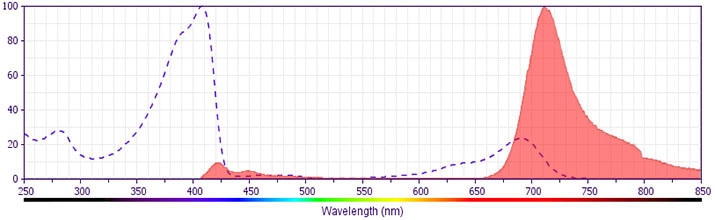
The antibody was conjugated to BD Horizon BV711 which is part of the BD Horizon Brilliant™ Violet family of dyes. This dye is a tandem fluorochrome of BD Horizon BV421 with an Ex Max of 405-nm and an acceptor dye with an Em Max at 711-nm. BD Horizon BV711 can be excited by the violet laser and detected in a filter used to detect Cy™5.5 / Alexa Fluor® 700-like dyes (eg, 712/20-nm filter). Due to the excitation and emission characteristics of the acceptor dye, there may be moderate spillover into the Alexa Fluor® 700 and PerCP-Cy5.5 detectors. However, the spillover can be corrected through compensation as with any other dye combination.
Please refer to Support Documents for Quality Certificates
Global - Refer to manufacturer's instructions for use and related User Manuals and Technical data sheets before using this products as described
Comparisons, where applicable, are made against older BD Technology, manual methods or are general performance claims. Comparisons are not made against non-BD technologies, unless otherwise noted.
For Research Use Only. Not for use in diagnostic or therapeutic procedures.