







Preparation And Storage


Recommended Assay Procedures
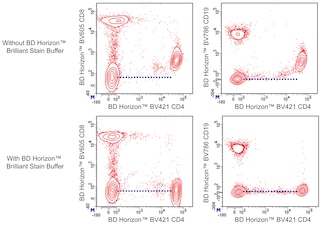
For optimal and reproducible results, BD Horizon Brilliant Stain Buffer should be used anytime two or more BD Horizon Brilliant dyes (including BD OptiBuild Brilliant reagents) are used in the same experiment. Fluorescent dye interactions may cause staining artifacts which may affect data interpretation. The BD Horizon Brilliant Stain Buffer was designed to minimize these interactions. More information can be found in the Technical Data Sheet of the BD Horizon Brilliant Stain Buffer (Cat. No. 563794).
Product Notices
- This antibody was developed for use in flow cytometry.
- The production process underwent stringent testing and validation to assure that it generates a high-quality conjugate with consistent performance and specific binding activity. However, verification testing has not been performed on all conjugate lots.
- Researchers should determine the optimal concentration of this reagent for their individual applications.
- An isotype control should be used at the same concentration as the antibody of interest.
- Caution: Sodium azide yields highly toxic hydrazoic acid under acidic conditions. Dilute azide compounds in running water before discarding to avoid accumulation of potentially explosive deposits in plumbing.
- For fluorochrome spectra and suitable instrument settings, please refer to our Multicolor Flow Cytometry web page at www.bdbiosciences.com/colors.
- Please refer to www.bdbiosciences.com/us/s/resources for technical protocols.
- BD Horizon Brilliant Stain Buffer is covered by one or more of the following US patents: 8,110,673; 8,158,444; 8,575,303; 8,354,239.
- BD Horizon Brilliant™ Violet 750 is covered by one or more of the following US patents: 8,158,444; 8,802,450; 8,575,303; 8,455,613; 8,227,187; 8,841,072; 8,110,673.
Companion Products
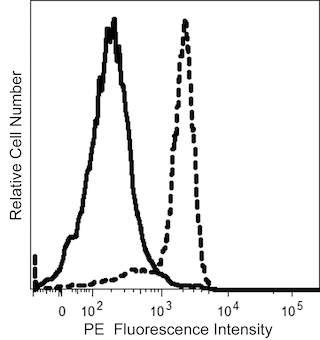
Lgr5 (leucine-rich-repeat-containing G-protein-coupled receptor 5) is a seven transmembrane-domain receptor that is a target gene for Wnt and marks stem cells in the small intestine, colon, stomach, and hair follicle. Lgr5 was initially identified as a potential stem cell marker due to restricted expression of Lgr5 in the intestinal crypt and labeling of rapidly cycling cells of the colon and intestine. Using both lineage tracing and organoid culture experiments, Lgr5 positive cells are capable of generating all types of the small intestine epithelium hence indicating that Lgr5 marks stem cells of the small intestine and colon. R-spondin growth factors, which are secreted agonists of the Wnt pathway, bind Lgr5. The binding of R-spondins to Lgr5 leads to recruitment of the Frizzled/LRP Wnt receptor complex, which binds to Wnt ligands and leads to downstream Wnt signaling. Lgr5 is up-regulated in colon and ovarian cancers and has been implicated in promotion of tumor growth and metastasis.
The 8F2 monoclonal antibody recognizes an epitope in the N-terminal region of Human Lgr5.
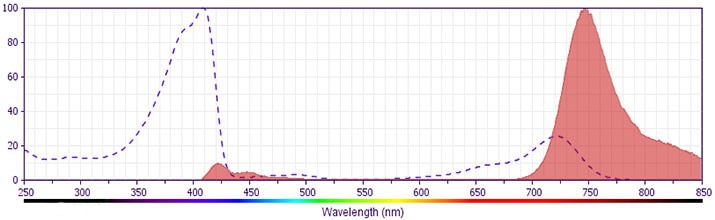
The antibody was conjugated to BD Horizon™ BV750 which is part of the BD Horizon Brilliant™ Violet family of dyes. This dye is a tandem fluorochrome of BD Horizon BV421 with an Ex Max of 405-nm and an acceptor dye with an Em Max at 750-nm. BD Horizon Brilliant BV750 can be excited by the violet laser (405 nm) and detected with a 750/30 nm filter with a 740 nm long pass. Due to spectral differences between labeled cells and beads, using BD™ CompBeads can result in incorrect spillover values when used with BD Horizon BV750 reagents. Therefore, the use of BD CompBeads or BD CompBeads Plus to determine spillover values for these reagents is not recommended.
Development References (8)
-
Barker N, Huch M, Kujala P, et al. Lgr5(+ve) stem cells drive self-renewal in the stomach and build long-lived gastric units in vitro. Cell Stem Cell. 2010; 6(1):25-36. (Biology). View Reference
-
Barker N, van Es JH, Kuipers J, Kujala P, van den Born M, et al. Identification of stem cells in small intestine and colon by marker gene Lgr5. Nature. 2007; 449(7165):1003-1007. (Biology). View Reference
-
Carmon KS, Gong X, Lin Q, Thomas A, Liu Q. R-spondins function as ligands of the orphan receptors LGR4 and LGR5 to regulate Wnt/{beta}-catenin signaling. Proc Natl Acad Sci U S A. 2011; 108(28):11452-11457. (Biology). View Reference
-
Jaks V, Barker N, Kasper M, et al. Lgr5 marks cycling, yet long-lived, hair follicle stem cells. Nat Genet. 2008; 40(11):1291-1299. (Biology). View Reference
-
Kemper K, Prasetyanti PR, de Lau W, Rodermond H, Clevers H, Medema JP. Monoclonal antibodies against Lgr5 identify human colorectal cancer stem cells. Stem Cells. 2012; 30(11):2378-2386. (Biology). View Reference
-
Merlos-Suárez A, Barriga FM, Jung P et al. The intestinal stem cell signature identifies colorectal cancer stem cells and predicts disease relapse. Cell Stem Cell. 2011; 8(5):511-524. (Biology). View Reference
-
Yui S, Nakamura T, Sato T, et al. Functional engraftment of colon epithelium expanded in vitro from a single adult Lgr5(+) stem cell. Nat Med. 2012; 18(4):618-623. (Biology). View Reference
-
de Lau W, Barker N, Low TY, et al. Lgr5 homologues associate with Wnt receptors and mediate R-spondin signalling. Nature. 2011; 476(7360):293-297. (Immunogen: Blocking). View Reference
Please refer to Support Documents for Quality Certificates
Global - Refer to manufacturer's instructions for use and related User Manuals and Technical data sheets before using this products as described
Comparisons, where applicable, are made against older BD Technology, manual methods or are general performance claims. Comparisons are not made against non-BD technologies, unless otherwise noted.
For Research Use Only. Not for use in diagnostic or therapeutic procedures.
