

The site is undergoing maintenance. Ordering can continue through fax and phone.
Sunday, August 16, 2026, 1:30 - 4:30 pm (CEST).
If you encounter problems while ordering. Please contact us at BDBCustomerService@bd.com
See More
The site is undergoing maintenance. Ordering can continue through fax and phone.
Sunday, August 16, 2026, 1:30 - 4:30 pm (CEST).
If you encounter problems while ordering. Please contact us at BDBCustomerService@bd.com
See MoreThe site is undergoing maintenance. Ordering can continue through fax and phone.
Sunday, August 16, 2026, 1:30 - 4:30 pm (CEST)
.If you encounter problems while ordering. Please contact us at BDBCustomerService@bd.com
This page has been recently translated and is available in French now.
Looks like you're visiting us from {countryName}.
Would you like to stay on the current location site or be switched to your location?
Any use of products other than the permitted use without the express written authorization of Becton, Dickinson and Company is strictly prohibited.
Interferon-γ (IFN-γ) is a potent multifunctional cytokine which is secreted by activated NK cells and CD4+TCRαβ+, CD8+TCRαβ+, and TCRγδ+ T cells. IFN-γ exerts its biological effects through specific binding to a single class of high affinity receptors. In addition to its antiviral effects, IFN-γ can upregulate a number of lymphoid cell functions including the antimicrobial and antitumor responses of macrophages, NK cells, and neutrophils. In addition, IFN-γ can exert strong regulatory influences on the proliferation, differentiation, and effector responses of B cell and T cell subsets. These influences can involve IFN-γ's capacity to boost MHC class I and II expression by antigen-presenting cells as well as direct effects on B cells and T cells themselves. Human IFN-γ is a 14 - 18 kD multiple glycosylated form protein containing 143 amino acid residues. Recombinant human IFN-γ (Cat. No. 554616) is supplied as a frozen liquid comprised of
0.22 μm sterile-filtered aqueous buffered solution containing bovine serum albumin, with no preservatives. Human IFN-γ is ≥ 95% pure as determined by SDS-PAGE and an absorbance assay based on the Beers-Lambert law. The endotoxin level is ≤ 0.1 ng/μg of human IFN-γ, as measured in a chromogenic LAL assay.
Upon initial thawing, recombinant human IFN-γ (Cat. No. 554616) should be aliquoted into polypropylene microtubes and frozen at -80°C for future use. Alternatively, the product can be diluted in sterile neutral buffer containing not less than 1 - 10 mg/mL carrier protein, such as human or bovine albumin, aliquoted and stored at -80°C. For in vitro biological assay use, carrier-protein concentrations of 1 - 2 mg/mL are recommended. For use as an ELISA standard, carrier-protein concentrations of 5 - 10 mg/mL are recommended. Failure to add carrier protein or store at indicated temperatures may result in a loss of activity. The product should not be diluted to less than 25 μg/mL for long term storage. Carrier proteins should be pre-screened for possible effects in each investigator's experimental system. Carrier proteins may have an undesired influence on experimental results due to toxicity, high endotoxin levels or possible blocking activity.
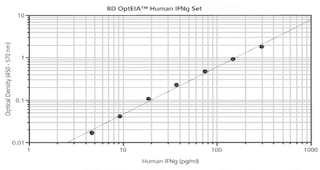
ELISA Standard: Recombinant human IFN-γ (Cat. No. 554616) can be useful as a quantitative standard for measuring human IFN-γ protein levels using sandwich ELISA with the purified NIB42 antibody (Cat. No. 551221) as a capture antibody and biotinylated 4S.B3 antibody
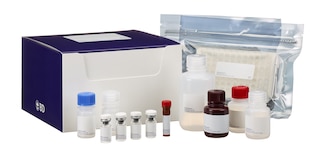
(Cat. No. 554550) as the detection antibody. To obtain linear standard curves, investigators may want to consider using doubling dilutions of recombinant human IFN-γ standard from 2000 - 15 pg/mL to be included in each ELISA plate. For measuring human IFN-γ in serum or plasma, investigators are highly encouraged to use the BD OptEIA™ Human IFN-γ ELISA Set (Cat. No. 555142 ) or BD OptEIA™ Human IFN-γ ELISA Kit II (Cat. No. 550612 ).
Bioassay: Investigators are advised that the Bioassay application is not routinely tested for this material and are highly encouraged to both titrate this material and include appropriate controls in relevant experiments. An activity range of 0.1 - 2.0 x 10^8 units/mg, encompassing an
ED50= 0.05 - 1.0 ng/mL, has previously been reported using A549 as indicator cells in an anti-viral bioassay, with a unit defined as the amount of material needed to stimulate a half-maximal response at cytokine saturation.
Please refer to Support Documents for Quality Certificates
Global - Refer to manufacturer's instructions for use and related User Manuals and Technical data sheets before using this products as described
Comparisons, where applicable, are made against older BD Technology, manual methods or are general performance claims. Comparisons are not made against non-BD technologies, unless otherwise noted.
For Research Use Only. Not for use in diagnostic or therapeutic procedures.