Dear Customer, If you experience any text readability or display issues on our website, please update your web browser to the latest version
.
See More
Dear Customer, If you experience any text readability or display issues on our website, please update your web browser to the latest version
.
See MoreDear Customer, If you experience any text readability or display issues on our website, please update your web browser to the latest version
.
This page has been recently translated and is available in French now.
Looks like you're visiting us from {countryName}.
Would you like to stay on the current location site or be switched to your location?
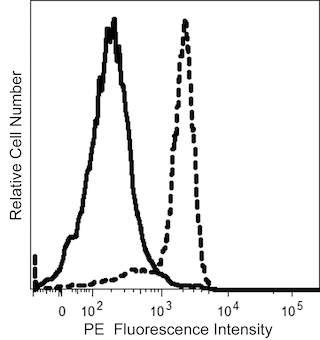
Multiparameter flow cytometric analysis using BD OptiBuild™ BV510 Mouse Anti-Human CD183 (CXCR3) antibody (Cat. No. 740183) on human peripheral blood. Flow cytometry was performed using a BD LSRFortessa™ X-20 Flow Cytometer System.
Any use of products other than the permitted use without the express written authorization of Becton, Dickinson and Company is strictly prohibited.
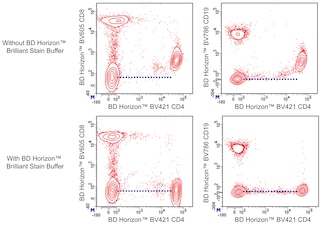
For optimal and reproducible results, BD Horizon Brilliant Stain Buffer should be used anytime two or more BD Horizon Brilliant dyes (including BD OptiBuild Brilliant reagents) are used in the same experiment. Fluorescent dye interactions may cause staining artifacts which may affect data interpretation. The BD Horizon Brilliant Stain Buffer was designed to minimize these interactions. More information can be found in the Technical Data Sheet of the BD Horizon Brilliant Stain Buffer (Cat. No. 563794).
The 1C6/CXCR3 monoclonal antibody specifically binds to human CD183, also known as the CXCR3 chemokine receptor. CD183 is a 40-41 kDa seven-transmembrane protein and member of the G protein-coupled receptor family. CD183 is expressed primarily on activated T cells that infiltrate inflammatory sites. It has also been detected on some circulating T cells, B cells, and NK cells. Reports show that some CXCR3-positive T cells also express CCR5 and are mostly CD45RO-positive cells. Three ligands for CXCR3 have been identified. They are CXCL9 (Mig/monokine induced by interferon-γ), CXCL10 (IP-10/interferon-γ inducible 10-kD protein), and CXCL11 (I-TAC/interferon-inducible T-cell alpha chemoattractant). These chemokines are produced by a variety of cells upon stimulation by IFN-γ and interact with CXCR3 to mediate T-cell chemotaxis. This reagent has been reported to be suitable for immunohistochemical staining of acetone-fixed, frozen sections and/or formalin-fixed, paraffin-embedded tissue sections with citrate pretreatment. Clone 1C6/CXCR3 also cross reacts with a subset of peripheral blood lymphocytes of baboon, and both rhesus and cynomolgus macaque monkeys. The distribution of lymphocytes is similar to that observed with CD183-positive peripheral blood lymphocytes from normal human donors. CXCR3 has been clustered as CD183 in the VIIth HLDA workshop.
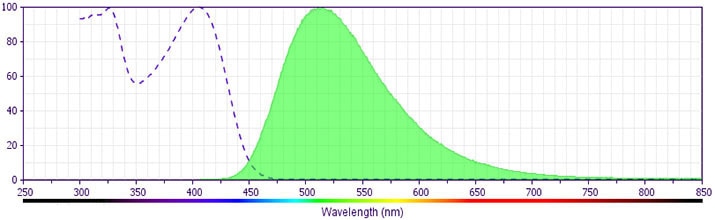
The antibody was conjugated to BD Horizon™ BV510 which is part of the BD Horizon Brilliant™ Violet family of dyes. With an Ex Max of 405-nm and Em Max at 510-nm, BD Horizon BV510 can be excited by the violet laser and detected in the BD Horizon V500 (525/50-nm) filter set. BD Horizon BV510 conjugates are useful for the detection of dim markers off the violet laser.
Please refer to Support Documents for Quality Certificates
Global - Refer to manufacturer's instructions for use and related User Manuals and Technical data sheets before using this products as described
Comparisons, where applicable, are made against older BD Technology, manual methods or are general performance claims. Comparisons are not made against non-BD technologies, unless otherwise noted.
Please refer to Support Documents for Quality Certificates
Global - Refer to manufacturer's instructions for use and related User Manuals and Technical data sheets before using this products as described
Comparisons, where applicable, are made against older BD Technology, manual methods or are general performance claims. Comparisons are not made against non-BD technologies, unless otherwise noted.
For Research Use Only. Not for use in diagnostic or therapeutic procedures.