







Preparation And Storage


Recommended Assay Procedures
For optimal and reproducible results, BD Horizon Brilliant Stain Buffer should be used anytime two or more BD Horizon Brilliant dyes are used in the same experiment. Fluorescent dye interactions may cause staining artifacts which may affect data interpretation. The BD Horizon Brilliant Stain Buffer was designed to minimize these interactions. More information can be found in the Technical Data Sheet of the BD Horizon Brilliant Stain Buffer (Cat. No. 563794/566349) or the BD Horizon Brilliant Stain Buffer Plus (Cat. No. 566385).
Product Notices
- This reagent has been pre-diluted for use at the recommended Volume per Test. We typically use 1 × 10^6 cells in a 100-µl experimental sample (a test).
- An isotype control should be used at the same concentration as the antibody of interest.
- Source of all serum proteins is from USDA inspected abattoirs located in the United States.
- Caution: Sodium azide yields highly toxic hydrazoic acid under acidic conditions. Dilute azide compounds in running water before discarding to avoid accumulation of potentially explosive deposits in plumbing.
- For fluorochrome spectra and suitable instrument settings, please refer to our Multicolor Flow Cytometry web page at www.bdbiosciences.com/colors.
- Alexa Fluor® is a registered trademark of Molecular Probes, Inc., Eugene, OR.
- BD Horizon Brilliant Violet 711 is covered by one or more of the following US patents: 8,110,673; 8,158,444; 8,227,187; 8,455,613; 8,575,303; 8,354,239.
- BD Horizon Brilliant Stain Buffer is covered by one or more of the following US patents: 8,110,673; 8,158,444; 8,575,303; 8,354,239.
- Cy is a trademark of GE Healthcare.
- Please refer to www.bdbiosciences.com/us/s/resources for technical protocols.
Companion Products
The 2A3 monoclonal antibody specifically binds to human CD25, the low-affinity alpha subunit of the Interleukin-2 Receptor (IL-2R α ). CD25 associates with CD122 (IL-2R β chain) and CD132 (common γ chain or γ c) to form the high-affinity signal-transducing IL-2R complex. CD25 is expressed by a subset of peripheral blood lymphocytes including CD4+CD25+ natural regulatory T cells. CD25 antigen density increases on activated T cells including phytohemagglutinin (PHA)-, concanavalin A (Con A)-, and CD3-activated T lymphocytes. High levels of CD25 can also be expressed by T lymphocytes from mixed lymphocyte cultures and by human T-lymphocyte leukemia virus (HTLV)-infected T-lymphocyte leukemia lines, for example, HUT-102. Recombinant IL-2 blocks the binding of the 2A3 antibody to PHA-activated T lymphocytes.
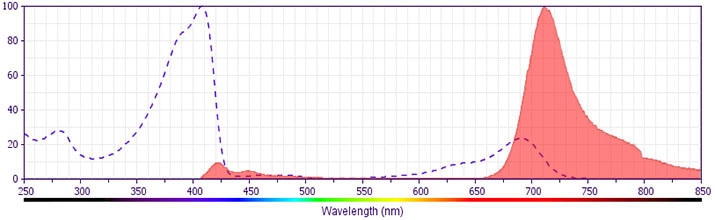
The antibody was conjugated to BD Horizon™ BV711 which is part of the BD Horizon™ Brilliant Violet™ family of dyes. This dye is a tandem fluorochrome of BD Horizon™ BV421 with an Ex Max of 405-nm and an acceptor dye with an Em Max at 711-nm. BD Horizon™ BV711 can be excited by the violet laser and detected in a filter used to detect Cy™5.5 / Alexa Fluor® 700-like dyes (eg, 712/20-nm filter). Due to the excitation and emission characteristics of the acceptor dye, there may be moderate spillover into the Alexa Fluor® 700 and PerCP-Cy™5.5 detectors. However, the spillover can be corrected through compensation as with any other dye combination.
Development References (13)
-
Dower SK, Hefeneider SH, Alpert AR, Urdal DL. Quantitative measurement of human interleukin 2 receptor levels with intact and detergent-solubilized human T-cells. Mol Immunol. 1985; 22(8):937-947. (Clone-specific). View Reference
-
Greene WC, Leonard WJ. The human interleukin-2 receptor. Annu Rev Immunol. 1986; 4:69-95. (Biology). View Reference
-
Jackson AL, Matsumoto H, Janszen M, Maino V, Blidy A, Shye S. Restricted expression of p55 interleukin 2 receptor (CD25) on normal T cells. Clin Immunol Immunopathol. 1990; 54(1):126-133. (Clone-specific: Flow cytometry). View Reference
-
Lando Z, Sarin P, Megson M, et al. Association of human T-cell leukaemia/lymphoma virus with the Tac antigen marker for the human T-cell growth factor receptor. Nature. 1983; 305(5936):733-736. (Biology). View Reference
-
Leonard WJ, Depper JM, Uchiyama T, Smith KA, Waldmann TA, Greene WC. A monoclonal antibody that appears to recognize the receptor for human T-cell growth factor; partial characterization of the receptor. Nature. 1982; 300(5889):267-269. (Biology). View Reference
-
Ng WF, Duggan PJ, Ponchel F, et al. Human CD4(+)CD25(+) cells: a naturally occurring population of regulatory T cells. Blood. 2001; 98(9):2736-2744. (Biology). View Reference
-
Rambaldi A, Young DC, Herrmann F, Cannistra SA, Griffin JD. Interferon-gamma induces expression of the interleukin 2 receptor gene in human monocytes. Eur J Immunol. 1987; 17(1):153-156. (Clone-specific). View Reference
-
Robb RJ, Greene WC, Rusk CM. Low and high affinity cellular receptors for interleukin 2. Implications for the level of Tac antigen. J Exp Med. 1984; 160(4):1126-1146. (Biology). View Reference
-
Schwarting R, Stein H. Cluster report: CD25. In: Knapp W. W. Knapp .. et al., ed. Leucocyte typing IV : white cell differentiation antigens. Oxford New York: Oxford University Press; 1989:399-403.
-
Sereti I, Martinez-Wilson H, Metcalf JA, et al. Long-term effects of intermittent interleukin 2 therapy in patients with HIV infection: characterization of a novel subset of CD4(+)/CD25(+) T cells. Blood. 2002; 100(6):2159-2167. (Clone-specific: Flow cytometry). View Reference
-
Siegel JP, Sharon M, Smith PL, Leonard WJ. The IL-2 receptor beta chain (p70): role in mediating signals for LAK, NK, and proliferative activities. Science. 1987; 238(4823):75-78. (Biology). View Reference
-
Teshigawara K, Wang HM, Kato K, Smith KA. Interleukin 2 high-affinity receptor expression requires two distinct binding proteins. J Exp Med. 1987; 165(1):223-238. (Biology). View Reference
-
Urdal DL, March CJ, Gillis S, Larsen A, Dower SK. Purification and chemical characterization of the receptor for interleukin 2 from activated human T lymphocytes and from a human T-cell lymphoma cell line. Proc Natl Acad Sci U S A. 1984; 81(20):6481-6485. (Immunogen). View Reference
Please refer to Support Documents for Quality Certificates
Global - Refer to manufacturer's instructions for use and related User Manuals and Technical data sheets before using this products as described
Comparisons, where applicable, are made against older BD Technology, manual methods or are general performance claims. Comparisons are not made against non-BD technologies, unless otherwise noted.
For Research Use Only. Not for use in diagnostic or therapeutic procedures.
