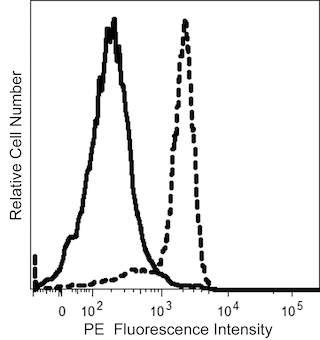
The MEM-238 monoclonal antibody specifically binds to CD222, which is also known as the Insulin-like growth factor 2 Receptor (IGF2R, IGF-II Receptor), Cation-independent mannose 6-phosphate receptor (CIMPR), or Mannose-6 phosphate receptor (M6PR). CD222 is ubiquitously expressed by a variety of cell types as a cell surface type I transmembrane glycoprotein. However, in the course of receptor trafficking between the cell surface and intracellular compartments, the majority of CD222 is found within cells. Cell surface CD222 functions as a multifunctional receptor that binds to a large number of extracellular ligands including acid hydrolases, insulin-like growth factors, latent TGF-β, leukemia inhibitory factor (LIF), proliferin, prorenin, plasminogen, and Herpes simplex virus. It regulates extracellular Insulin-like growth factor II (IGF-II/IGF-2) levels by binding and internalizing the growth factor for lysosomal degradation. This effectively removes IGF-II from the circulation and tissues and thus prevents it from signaling through the growth-stimulatory Insulin-like growth factor I Receptor (IGF-1R, CD221) pathway. However, studies have reported that IGF-II may activate some cellular functions through CD222 as well. A soluble form of the CD222 extracellular region can also be detected in human serum and may play a role in regulating IGF-II activity. CD222 serves as a surface receptor for latent TGFβ and can complex with plasminogen and CD87, a urokinase-type plasminogen activator receptor, to activate latent TGF-β. CD222 also binds to a variety of Mannose 6-phosphate (M6P)-containing proteins, including extracellular and newly-synthesized lysosomal enzymes, and transports them to lysosomes.
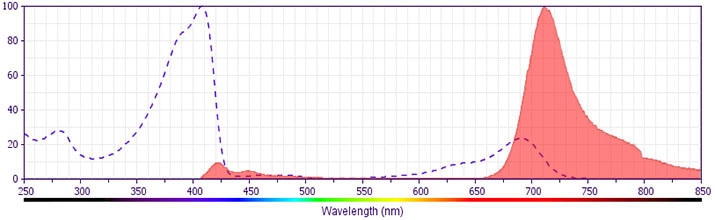
The antibody was conjugated to BD Horizon™ BV711 which is part of the BD Horizon Brilliant™ Violet family of dyes. This dye is a tandem fluorochrome of BD Horizon BV421 with an Ex Max of 405-nm and an acceptor dye with an Em Max at 711-nm. BD Horizon BV711 can be excited by the violet laser and detected in a filter used to detect Cy™5.5 / Alexa Fluor® 700-like dyes (eg, 712/20-nm filter). Due to the excitation and emission characteristics of the acceptor dye, there may be moderate spillover into the Alexa Fluor® 700 and PerCP-Cy5.5 detectors. However, the spillover can be corrected through compensation as with any other dye combination.