







Preparation And Storage


Recommended Assay Procedures
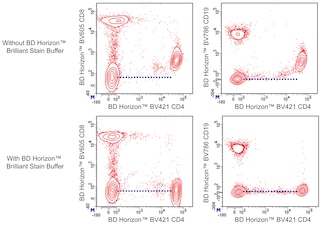
For optimal and reproducible results, BD Horizon Brilliant Stain Buffer should be used anytime two or more BD Horizon Brilliant dyes are used in the same experiment. Fluorescent dye interactions may cause staining artifacts which may affect data interpretation. The BD Horizon Brilliant Stain Buffer was designed to minimize these interactions. More information can be found in the Technical Data Sheet of the BD Horizon Brilliant Stain Buffer (Cat. No. 563794 or 566349).
When setting up compensation, it is recommended to compare spillover values obtained from cells and BD™ CompBeads to ensure that beads will provide sufficiently accurate spillover values.
For optimal results, it is recommended to perform two washes after staining with antibodies. Cells may be prepared, stained with antibodies and washed twice with wash buffer per established protocols for immunofluorescent staining prior to acquisition on a flow cytometer. Performing fewer than the recommended wash steps may lead to increased spread of the negative population.
Product Notices
- This antibody was developed for use in flow cytometry.
- The production process underwent stringent testing and validation to assure that it generates a high-quality conjugate with consistent performance and specific binding activity. However, verification testing has not been performed on all conjugate lots.
- Researchers should determine the optimal concentration of this reagent for their individual applications.
- An isotype control should be used at the same concentration as the antibody of interest.
- Caution: Sodium azide yields highly toxic hydrazoic acid under acidic conditions. Dilute azide compounds in running water before discarding to avoid accumulation of potentially explosive deposits in plumbing.
- For fluorochrome spectra and suitable instrument settings, please refer to our Multicolor Flow Cytometry web page at www.bdbiosciences.com/colors.
- Please refer to www.bdbiosciences.com/us/s/resources for technical protocols.
- BD Horizon Brilliant Stain Buffer is covered by one or more of the following US patents: 8,110,673; 8,158,444; 8,575,303; 8,354,239.
- BD Horizon Brilliant Blue 700 is covered by one or more of the following US patents: 8,455,613 and 8,575,303.
- Cy is a trademark of GE Healthcare.
Companion Products
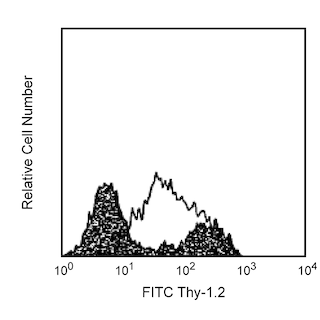
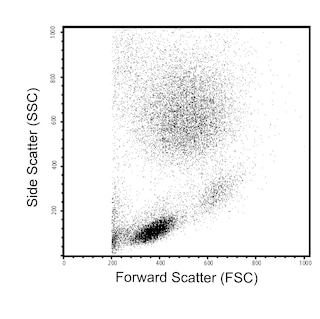
The 4D11 antibody specifically recognizes Ly-49G2 (also known as LGL-1), an inhibitory receptor which is expressed on subsets of natural killer (NK) cells and DX5-positive T lymphocytes (NK-T cells) in all strains tested (e.g., AKR/N, BALB/c, C3H/HeJ, C57BL/6, CBA/J, DBA/2, SJL, 129) and on a population of memory CD8+ T lymphocytes in C57BL/6 mice. Cross-reaction of 4D11 antibody to Ly-49A[B6], Ly-49A[BALB], and Ly-49T[129/J] inhibitory receptors and Ly-49L[CBA/J] activating receptor has been reported. The proportion of NK-T cells expressing Ly-49A and Ly-49G2 is higher (2-5 fold) in thymus than in liver (immature and mature NK-T cells, respectively), and there is evidence that down-regulation of Ly-49 receptor expression is necessary for normal NK-T-cell development to occur. Most NK cells express a single allele of Ly-49A and/or Ly-49G2, although occasionally they may express more than one allele. The Ly-49 family of NK-cell receptors, members of the C-type lectin superfamily, are disulfide-linked type-II transmembrane protein homodimers with extracellular carbohydrate-recognition domains, which bind to MHC class I alloantigens. The Ly-49 family members are expressed independently, such that an individual NK or T cell may display more than one class of Ly-49 receptor homodimers. Binding of Ly-49G[B6]-expressing transfectants to H-2Dd+/H-2Ld+ ConA blasts has been demonstrated, and H-2D[d]-expressing target cells inhibit the lytic activity of Ly-49G2-expressing NK cells. The levels of the Ly-49 inhibitory receptors are down-regulated by their ligands in vivo, and the various levels of expression of a Ly-49 inhibitory receptor may affect the specificity of NK cells. Ly-49G2[+] NK cells are able to lyse target tumor cells expressing H-2[a] and H-2[b] MHC class I antigens in vitro, and they mediate allogeneic and hybrid resistance to H-2[b] bone marrow transplantation. The Ly-49A[BALB] and Ly-49A[B6] alloantigens bind to MHC class I antigens of the d and k haplotypes, and Ly-49A[+] IL-2-activated NK cells are unable to lyse target cells expressing H-2[d] and H-2[k]. In vitro studies suggest that the Ly-49G2 and Ly-49A receptors mediate negative regulation of NK-cell cytolytic activity via tyrosine phosphorylation of their ITIMs (Immunoreceptor Tyrosine-based Inhibitory Motifs). Ly-49T[129/J] has a unique ITIM sequence, and Ly-49T-transfected 293T (human kidney epithelial) cells do not bind soluble tetramers of any tested H-2 alloantigen (D[b], D[d], D[k], K[b], K[d], K[k], L[d]).
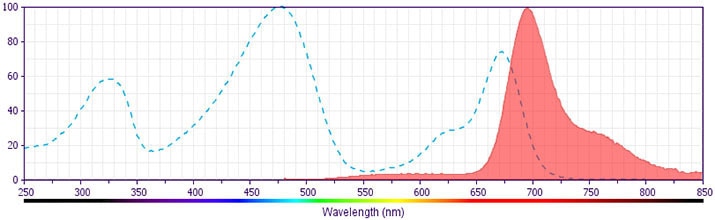
The antibody was conjugated to BD Horizon™ BB700, which is part of the BD Horizon Brilliant™ Blue family of dyes. It is a polymer-based tandem dye developed exclusively by BD Biosciences. With an excitation max of 485 nm and an emission max of 693 nm, BD Horizon BB700 can be excited by the 488 nm laser and detected in a standard PerCP-Cy™5.5 set (eg, 695/40-nm filter). This dye provides a much brighter alternative to PerCP-Cy5.5 with less cross laser excitation off the 405 nm and 355 nm lasers.
Development References (19)
-
Coles MC, McMahon CW, Takizawa H, Raulet DH. Memory CD8 T lymphocytes express inhibitory MHC-specific Ly49 receptors. Eur J Immunol. 2000; 30(1):236-244. (Biology). View Reference
-
Hanke T, Takizawa H, McMahon CW, et al. Direct assessment of MHC class I binding by seven Ly49 inhibitory NK cell receptors. Immunity. 1999; 11(1):67-77. (Biology). View Reference
-
Held W, Kunz B. An allele-specific, stochastic gene expression process controls the expression of multiple Ly49 family genes and generates a diverse, MHC-specific NK cell receptor repertoire. Eur J Immunol. 1998; 28(8):2407-2416. (Biology). View Reference
-
Hoglund P, Sundback J, Olsson-Alheim MY, et al. Host MHC class I gene control of NK-cell specificity in the mouse. Immunol Rev. 1997; 155:11-28. (Biology). View Reference
-
Makrigiannis AP, Etzler J, Winkler-Pickett R, Mason A, Ortaldo JR, Anderson SK. Identification of the Ly49L protein: evidence for activating counterparts to inhibitory Ly49 proteins. J Leukoc Biol. 2000; 68(5):765-771. (Biology). View Reference
-
Makrigiannis AP, Pau AT, Saleh A, Winkler-Pickett R, Ortaldo JR, Anderson SK. Class I MHC-binding characteristics of the 129/J Ly49 repertoire. J Immunol. 2001; 166(8):5034-5043. (Biology). View Reference
-
Mason L, Giardina SL, Hecht T, Ortaldo J, Mathieson BJ. LGL-1: a non-polymorphic antigen expressed on a major population of mouse natural killer cells. J Immunol. 1988; 140(12):4403-4412. (Immunogen). View Reference
-
Mason LH, Gosselin P, Anderson SK, Fogler WE, Ortaldo JR, McVicar DW. Differential tyrosine phosphorylation of inhibitory versus activating Ly-49 receptor proteins and their recruitment of SHP-1 phosphatase. J Immunol. 1997; 159(9):4187-4196. (Biology). View Reference
-
Mason LH, Ortaldo JR, Young HA, Kumar V, Bennett M, Anderson SK. Cloning and functional characteristics of murine large granular lymphocyte-1: a member of the Ly-49 gene family (Ly-49G2). J Exp Med. 1995; 182(2):293-303. (Clone-specific). View Reference
-
Mason LH, Yagita H, Ortaldo JR. LGL-1: a potential triggering molecule on murine NK cells. J Leukoc Biol. 1994; 55(3):362-370. (Clone-specific). View Reference
-
Olsson-Alheim MY, Salcedo M, Ljunggren HG, Karre K, Sentman CL. NK cell receptor calibration: effects of MHC class I induction on killing by Ly49Ahigh and Ly49Alow NK cells. J Immunol. 1997; 159(7):3189-3194. (Biology). View Reference
-
Ortaldo JR, Mason AT, Winkler-Pickett R, Raziuddin A, Murphy WJ, Mason LH. Ly-49 receptor expression and functional analysis in multiple mouse strains. J Leukoc Biol. 1999; 66(3):512-520. (Biology). View Reference
-
Ortaldo JR, Winkler-Pickett R, Mason AT, Mason LH. The Ly-49 family: regulation of cytotoxicity and cytokine production in murine CD3+ cells. J Immunol. 1998; 160(1):1158-1165. (Clone-specific). View Reference
-
Raulet DH, Held W, Correa I, Dorfman JR, Wu MF, Corral L. Specificity, tolerance and developmental regulation of natural killer cells defined by expression of class I-specific Ly49 receptors. Immunol Rev. 1997; 155:41-52. (Biology). View Reference
-
Raziuddin A, Longo DL, Mason L, Ortaldo JR, Bennett M, Murphy WJ. Differential effects of the rejection of bone marrow allografts by the depletion of activating versus inhibiting Ly-49 natural killer cell subsets. J Immunol. 1998; 160(1):87-94. (Biology). View Reference
-
Raziuddin A, Longo DL, Mason L, Ortaldo JR, Murphy WJ. Ly-49 G2+ NK cells are responsible for mediating the rejection of H-2b bone marrow allografts in mice. Int Immunol. 1996; 8(12):1833-1839. (Biology). View Reference
-
Robson MacDonald H, Lees RK, Held W. Developmentally regulated extinction of Ly-49 receptor expression permits maturation and selection of NK1.1+ T cells. J Exp Med. 1998; 187(12):2109-2114. (Biology). View Reference
-
Skold M, Cardell S. Differential regulation of Ly49 expression on CD4+ and CD4-CD8- (double negative) NK1.1+ T cells. Eur J Immunol. 2000; 30(9):2488-2496. (Clone-specific). View Reference
-
Takei F, Brennan J, Mager DL. The Ly-49 family: genes, proteins and recognition of class I MHC. Immunol Rev. 1997; 155:67-77. (Biology). View Reference
Please refer to Support Documents for Quality Certificates
Global - Refer to manufacturer's instructions for use and related User Manuals and Technical data sheets before using this products as described
Comparisons, where applicable, are made against older BD Technology, manual methods or are general performance claims. Comparisons are not made against non-BD technologies, unless otherwise noted.
For Research Use Only. Not for use in diagnostic or therapeutic procedures.
