





Compensation or spectral unmixing is critical when setting up flow cytometry experiments to correct fluorescence spillover that can lead to biological artifacts. While single-color stained cells are the preferred controls, microparticles (beads) that bind species-specific antibodies provide a reliable alternative for compensation and spectral unmixing. Beads are especially useful when cell samples are limited, cell population frequency is low, or when markers are variably expressed. It is important to validate any chosen single-color control to ensure accurate fluorescence spillover correction and compatibility with the specific workflow, protocol or application being performed.
Compared with cells, compensation beads provide a bright, consistent signal that is independent of biological variability, helping ensure reliable fluorescence correction over time. Their ease of use, long-term consistency, and ability to generate signals that are often brighter than the biological sample make them a convenient and dependable choice for routine workflows, complex panels, and situations where cell samples are limited.
Why Choose Compensation Beads for Flow Cytometry?
Reliable compensation and spectral unmixing begin with single-color controls that accurately represent the stained sample. When the spectral profile of a control differs from the biological sample, spillover correction may be less accurate. For this reason, controls should generate clearly separated positive and negative populations with signal intensity equal to or brighter than the sample being analyzed. Compensation beads provide a convenient solution by delivering bright, consistent signals that are not dependent on biological marker expression or sample availability.
Benefits of compensation and spectral unmixing beads:
- Consistent antibody binding: Compensation beads provide a standardized binding surface for fluorochrome-conjugated antibodies, reducing variability associated with endogenous marker expression on cells.
- Bright, uniform signals: Beads can generate consistent positive populations with signal intensities equal to or brighter than the biological sample, supporting clear positive-negative separation for compensation and spectral unmixing.
- Reliable performance over time: Standardized bead-based controls help support consistent signal generation across experiments, making them useful for routine workflows and longitudinal studies.
- Supports limited or difficult samples: Beads provide single-color controls without consuming valuable biological material, which is especially useful when sample volume is limited, target populations are rare or markers are variably expressed.
- Easy to incorporate into workflows: Ready-to-use or simple staining protocols make compensation beads a convenient option for routine panel setup, assay transfer and multi-parameter flow cytometry applications.
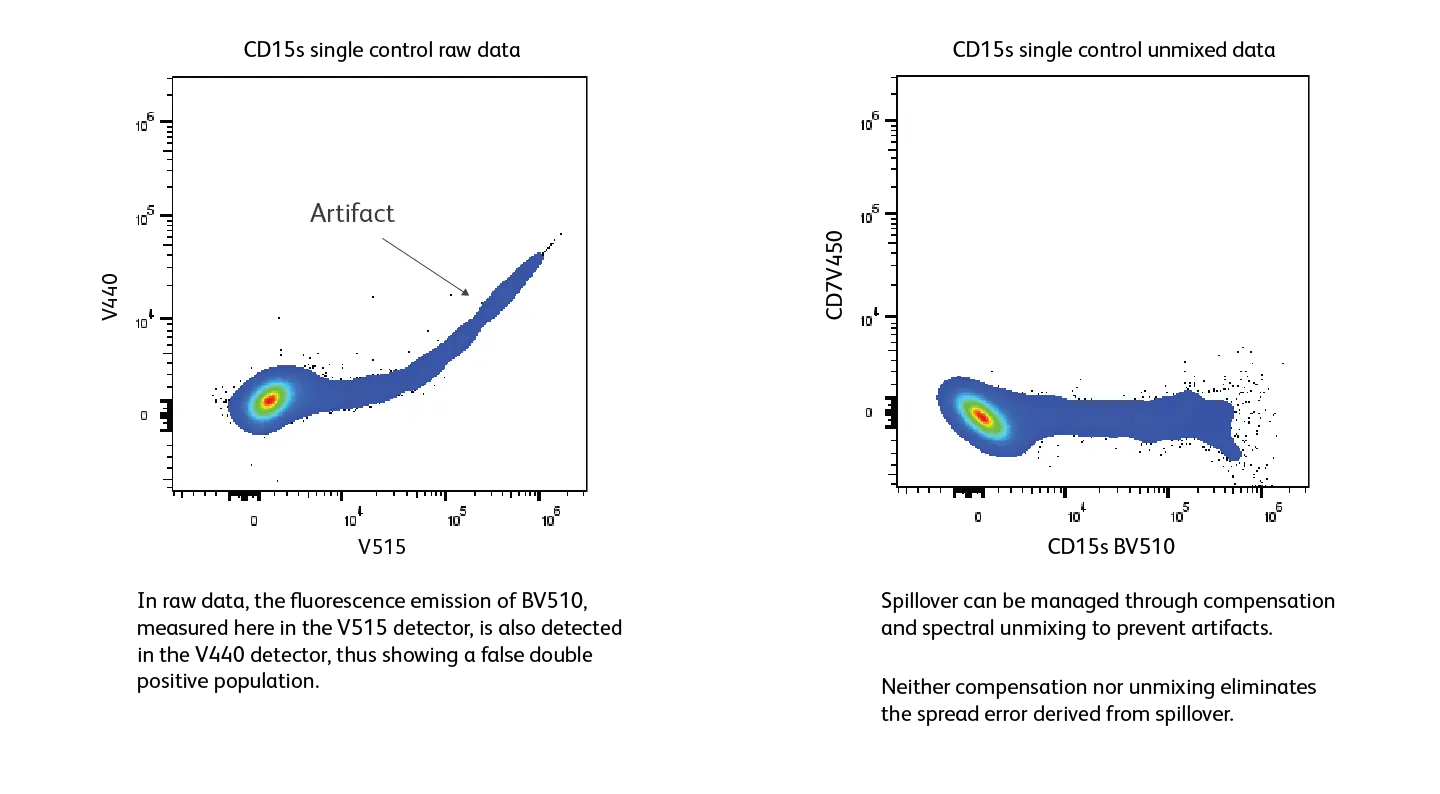
Fluorescence Spillover Can Create Biological Artifacts and Impact Resolution
Reliable single-color controls help build accurate compensation and unmixing matrices.
Fluorochrome emission spectra can overlap, which can make it difficult to distinguish signal from individual fluorochromes in a multi-parameter panel. In conventional flow cytometry, compensation corrects for spillover of fluorescence signal into additional detectors. In spectral flow cytometry, spectral unmixing separates overlapping fluorochrome signatures using the measured emission profile of each fluorochrome. Single-color controls, prepared with cells or beads, are used to define these fluorescence profiles and support accurate correction
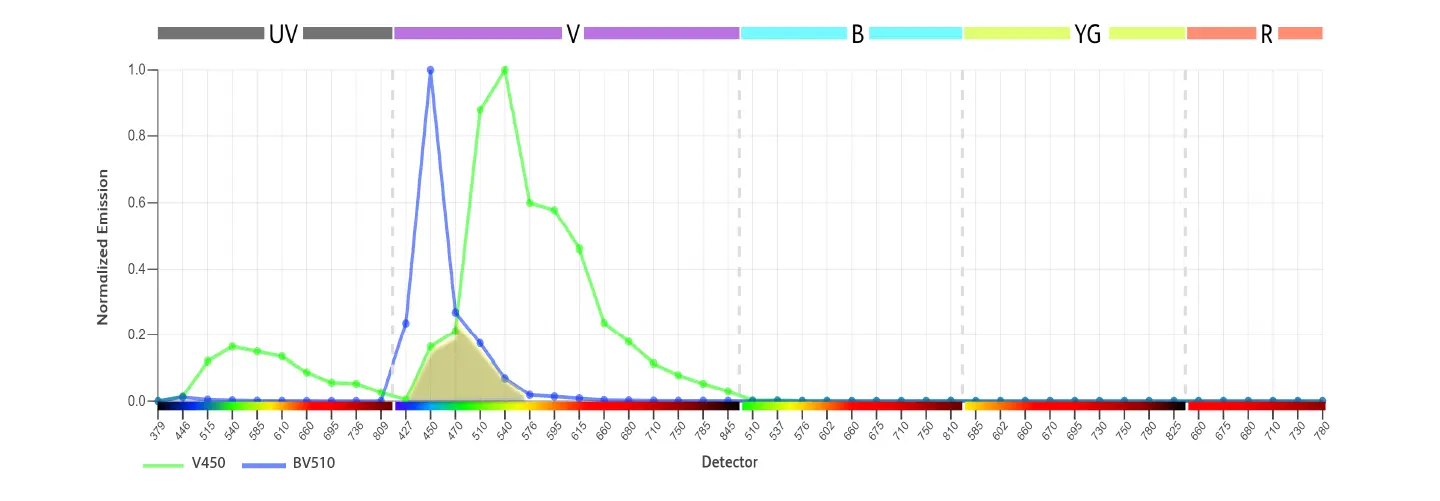
Representative emission profiles of two partially overlapping fluorochromes. Spillover refers to the amount of overlap between two emission profiles.
How to Choose Compensation and Spectral Unmixing Beads
Choose compensation or spectral unmixing beads based on the reagent being detected, the required binding specificity and the needs of the application. For single-color antibodies, select beads that are compatible with the antibody species and isotype.
Bead format can also support workflow flexibility. Single-vial bead formats can simplify setup by providing positive and negative populations in one tube. Depending on the workflow, a universal negative bead population may also be used, either as part of a combination set or by preparing antibody-capture beads without adding a fluorochrome-conjugated antibody.
For workflows that require brighter signal and enhanced signal-to-noise resolution, BD™ SpectraComp™ Beads or BD™ CompBead Plus 7.5 µm Particles may be useful options. In all cases, the selected control should provide clear positive-negative separation and a positive signal equal to or brighter than the biological sample.
Products for Compensation and Spectral Unmixing
Product | Reactivity | Format | Light chain recognized |
Human, Rabbit, Mouse, Rat, Hamster (Armenian, Syrian) | Single vial with both positive and negative beads | Kappa & lambda | |
Mouse, Rat, Hamster (Armenian, Syrian) | Single vial with both positive and negative beads | Kappa & lambda | |
BD™ CompBeads Anti-Mouse Ig, κ/Negative Control Compensation Particles Set | Mouse | Separate vials for positive and negative beads | Kappa |
BD™ CompBeads Anti-Rat Ig, κ/Negative Control Compensation Particles Set | Rat | Separate vials for positive and negative beads | Kappa |
BD™ CompBeads Anti-Rat and Anti-Hamster Ig κ /Negative Control Compensation Particles Set | Rat, Hamster (Armenian, Syrian) | Separate vials for positive and negative beads | Kappa |
BD™ CompBead Plus Anti-Mouse Ig, κ/Negative Control (BSA) Compensation Plus (7.5 µm) Particles Set | Mouse | Separate vials for positive and negative beads | Kappa |
BD™ CompBead Plus Anti-Rat Ig, κ/Negative Control (BSA) Compensation Plus (7.5 µm) Particles Set | Rat | Separate vials for positive and negative beads | Kappa |
Simplify Compensation and Unmixing with BD™ SpectraComp™ Beads
Complex panels require multiple single-color controls, which can add time and variability. Accurate compensation or spectral unmixing depends on controls that are compatible with the reagent, clearly separated from the negative control and representative of the stained sample.
BD™ SpectraComp™ Unmixing and Compensation Particles simplify control setup by providing positive and negative particles in a single vial. BD™ SpectraComp™ Unmixing and Compensation Particles support mouse, rat and hamster antibodies, while BD™ SpectraComp™ XT Unmixing and Compensation Particles expand compatibility to include human and rabbit antibodies.
Advantages of BD™ SpectraComp™ Unmixing and Compensation Particles:
- Broad species reactivity with mouse, rat and hamster antibodies, and expanded human and rabbit compatibility with BD™ SpectraComp™ XT Particles.
- κ- and λ-light-chain binding to support a broad range of single-color antibodies.
- Single-vial format with positive and negative particles to simplify single-color control setup.
- Designed for compensation and spectral unmixing workflows across conventional and spectral flow cytometry applications.
- Compatible with BD fluorochromes and common workflow buffers, including BD Horizon RealViolet™, RealBlue™, RealYellow™ and RealRed™ Fluorochromes.
- Supports analyzer and sorter workflows where bright, clearly resolved controls are needed for panel-specific fluorescence correction.
How to Use Compensation and Spectral Unmixing Beads?
Compensation and spectral unmixing beads are used similarly to cell-based single-color controls. For accurate results, process bead controls under conditions that match the experimental samples, including the same fluorochrome-conjugated reagents, buffers and sample preparation steps such as lysis, fixation or permeabilization when applicable.
- Prepare bead controls. Prepare one single-color control for each fluorochrome-conjugated reagent, plus an unstained or negative control as appropriate. Add the selected compensation or spectral unmixing beads to each tube or well.
- Add the fluorochrome-conjugated reagent. Add the matching antibody or reagent using an amount predetermined by an optimization test to provide clear positive-negative separation, with a positive bead signal that is equal to or brighter than the biological sample but remains on scale.
- Match the sample workflow. Process stained bead controls using the same relevant buffers and preparation steps as the experimental samples, such as staining buffer, lysis, fixation or permeabilization.
- Wash, resuspend and acquire. Wash and resuspend the bead controls, then acquire each control using the same instrument settings planned for the experimental samples. Gate on the appropriate bead population by scatter parameters and confirm that fluorescence signals remain on scale before generating the matrix.
- Generate and verify the matrix. Gate on the appropriate positive and negative bead populations to generate the matrix. If the in-tube negative population does not support accurate matrix generation, a universal negative bead population may be used as an alternative. Check accuracy with an NxN matrix to confirm appropriate fluorescence correction for all fluorochromes in the panel.
For a more detailed protocol, please refer to the BD™ SpectraComp™ Particles, BD™ SpectraComp™ XT Particles and BD™ CompBeads™ Technical Data Sheets.
FAQs
- What are compensation and spectral unmixing beads?
Compensation and spectral unmixing beads are microparticles used to prepare single-color controls for flow cytometry. Depending on the product, these particles may be polystyrene beads or engineered cell-like particles designed to bind fluorochrome-conjugated antibodies through species- and light-chain-specific recognition. When stained with a single fluorochrome-conjugated antibody, the beads provide positive and negative control populations that can be used to generate a compensation or spectral unmixing matrix.
- When should I use compensation beads instead of cells?
Compensation beads may be used when cell-based single-color controls are difficult to prepare or do not provide a clearly resolved positive population. They are especially useful when sample material is limited, target populations are rare, markers are variably expressed or biological samples do not provide enough signal for reliable control setup.
- Can compensation beads be used for spectral flow cytometry?
Yes, compensation and spectral unmixing beads can be used to generate single-color controls for both conventional and spectral flow cytometry.
- What is the difference between compensation and spectral unmixing?
Both compensation and spectral unmixing correct fluorescence spillover using single-color controls. Compensation is used in conventional flow cytometry to correct detector overlap, while spectral unmixing uses full emission profiles to separate fluorochromes in spectral flow cytometry.
- Do compensation beads work with all fluorochromes?
Compensation beads can be used with many fluorochrome-conjugated antibodies, but compatibility depends on the bead type, antibody species or isotype, and the specific reagent being tested. Some dyes or reagents may require cell-based controls if the bead-stained control does not accurately represent the stained sample. Validate each bead control within the intended panel and workflow to confirm accurate compensation or spectral unmixing.
Cy is a trademark of Global Life Sciences Solutions Germany GmbH or an affiliate doing business as Cytiva.
For Research Use Only. Not for use in diagnostic or therapeutic procedures.