





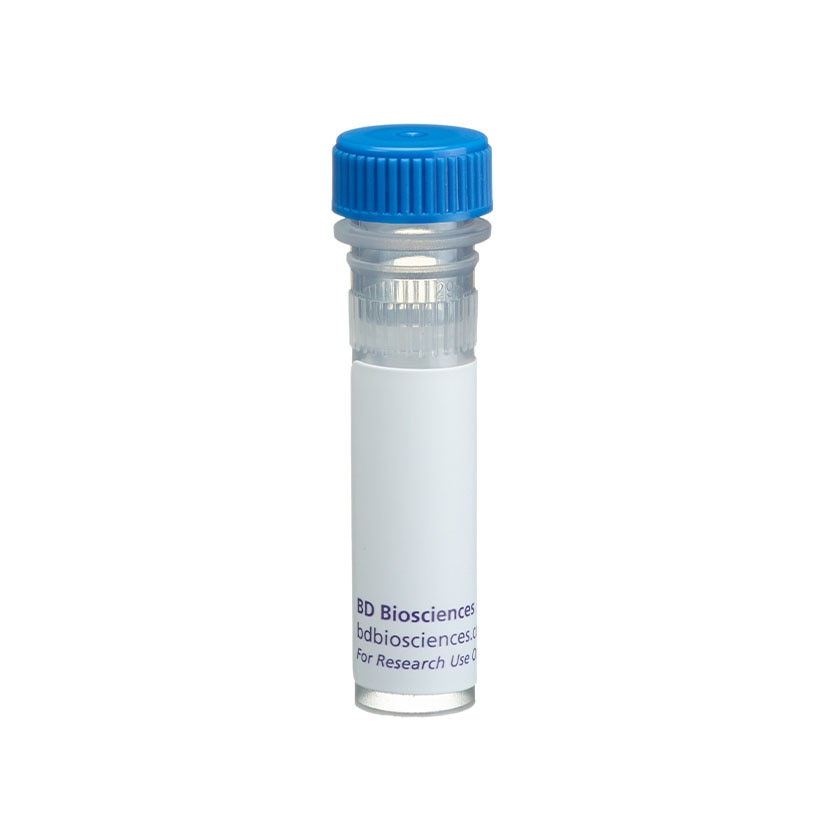
BD Pharmingen™ Purified Mouse Anti-Rat CD63
Clone AD1 (RUO)


The expression of CD63 on rat CD54+ peritoneal lavage cells. Lewis rat peritoneal lavage cells were incubated simultaneously with either purified Mouse IgG1, κ isotype control (Cat. no. 557273, open histogram) or purified AD1 mAb (shaded histogram), followed by biotinylated A85-1 mAb (rat anti-mouse IgG1, Cat. no. 553441) and finally Streptavidin-FITC (Cat. no. 554060) and PE-conjugated 1A29 mAb (anti-rat CD54, Cat. no. 554970). For analysis, a gate was drawn to include CD54+ cells only (gate not shown). Flow cytometry was performed on a BD FACSCalibur™ flow cytometry system.
The expression of CD63 on rat CD54+ peritoneal lavage cells. Lewis rat peritoneal lavage cells were incubated simultaneously with either purified Mouse IgG1, κ isotype control (Cat. no. 557273, open histogram) or purified AD1 mAb (shaded histogram), followed by biotinylated A85-1 mAb (rat anti-mouse IgG1, Cat. no. 553441) and finally Streptavidin-FITC (Cat. no. 554060) and PE-conjugated 1A29 mAb (anti-rat CD54, Cat. no. 554970). For analysis, a gate was drawn to include CD54+ cells only (gate not shown). Flow cytometry was performed on a BD FACSCalibur™ flow cytometry system.


Preparation And Storage


Product Notices
- Since applications vary, each investigator should titrate the reagent to obtain optimal results.
- Please refer to www.bdbiosciences.com/us/s/resources for technical protocols.
- Caution: Sodium azide yields highly toxic hydrazoic acid under acidic conditions. Dilute azide compounds in running water before discarding to avoid accumulation of potentially explosive deposits in plumbing.
Companion Products
The AD1 monoclonal antibody specifically recognizes a 50-60-kDa protein that is a homolog (87%) of human CD63 (melanomaassociated antigen ME491). CD63, a highly glycosylated type-III lysosomal glycoprotein, is a member of the tetraspan transmembrane 4 superfamily (TM4SF) that also includes CD9, CD37, and CD53. In the rat, CD63 is expressed on mast cells and platelets. CD63 is also found on rat embryonic fibroblasts and hepatic cell, along with cultured cell lines of diverse origin (eg, liver, lung, and heart). CD63 expression is upregulated with culture. CD63 is expressed in close proximity to the FcεRI on rat mast cells and has been shown to partially inhibit IgE-mediated histamine release. The function of CD63 has not been fully characterized.
Development References (4)
-
Barclay NA, Brown MH, Birkeland ML, et al, ed. The Leukocyte Antigen FactsBook. San Diego, CA: Academic Press; 1997.
-
Boros M, Takaichi S, Masuda J, Newlands GF, Hatanaka K. Response of mucosal mast cells to intestinal ischemia-reperfusion injury in the rat. Shock. 1995; 3(2):125-131. (Clone-specific: Immunohistochemistry). View Reference
-
Kitani S, Berenstein E, Mergenhagen S, Tempst P, Siraganian RP. A cell surface glycoprotein of rat basophilic leukemia cells close to the high affinity IgE receptor (Fc epsilon RI). Similarity to human melanoma differentiation antigen ME491. J Biol Chem. 1991; 266(3):1903-1909. (Immunogen: Immunoprecipitation). View Reference
-
Nishikata H, Oliver C, Mergenhagen SE, Siraganian RP. The rat mast cell antigen AD1 (homologue to human CD63 or melanoma antigen ME491) is expressed in other cells in culture. J Immunol. 1992; 149(3):862-870. (Biology). View Reference
Please refer to Support Documents for Quality Certificates
Global - Refer to manufacturer's instructions for use and related User Manuals and Technical data sheets before using this products as described
Comparisons, where applicable, are made against older BD Technology, manual methods or are general performance claims. Comparisons are not made against non-BD technologies, unless otherwise noted.
Please refer to Support Documents for Quality Certificates
Global - Refer to manufacturer's instructions for use and related User Manuals and Technical data sheets before using this products as described
Comparisons, where applicable, are made against older BD Technology, manual methods or are general performance claims. Comparisons are not made against non-BD technologies, unless otherwise noted.
For Research Use Only. Not for use in diagnostic or therapeutic procedures.