







Preparation And Storage


Product Notices
- Since applications vary, each investigator should titrate the reagent to obtain optimal results.
- Please refer to www.bdbiosciences.com/us/s/resources for technical protocols.
- Caution: Sodium azide yields highly toxic hydrazoic acid under acidic conditions. Dilute azide compounds in running water before discarding to avoid accumulation of potentially explosive deposits in plumbing.
Companion Products
.png?imwidth=320)
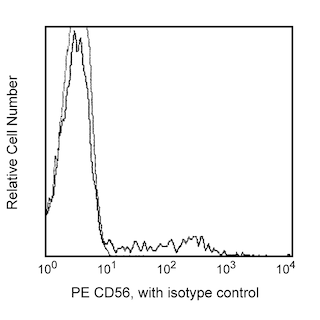
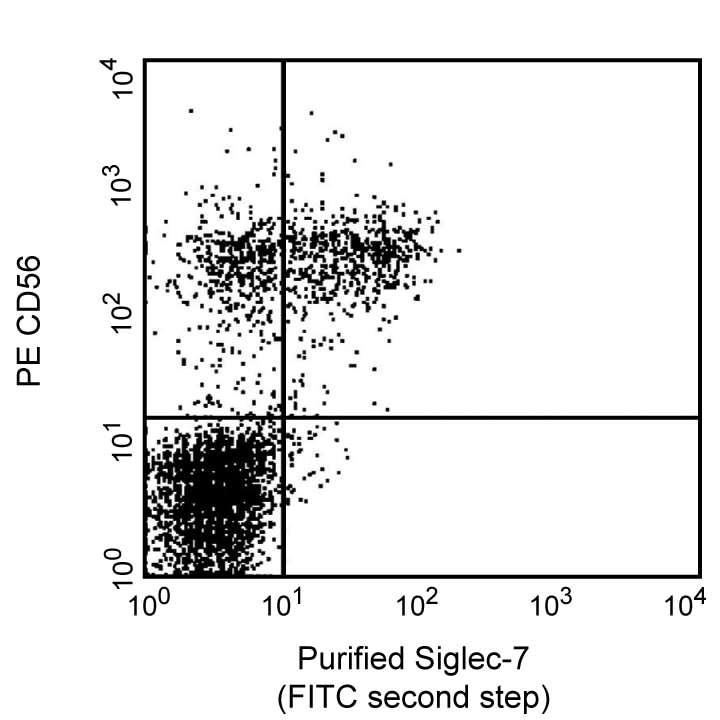
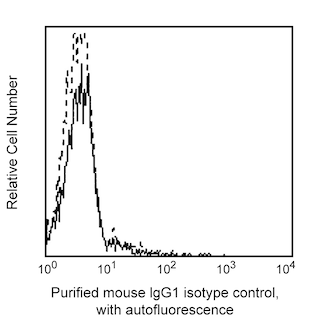
The F023-420 monoclonal antibody specifically recognizes CD328 which is also known as sialic acid binding Ig like lectin 7 (Siglec-7). CD238 is an I-type lectin of approximately 65 kDa, expressed as a monomer on a major subset of NK cells and a subset of CD8+ cells. It is also expressed at moderate levels on monocytes and weakly on granulocytes. Siglecs (sialic acid/immunoglobulin/lectin) are a family of I-type lectins that bind to sialic acids on the cell surface. They are a family of carbohydrate binding proteins within the immunoglobulin superfamily. Siglecs are integral membrane proteins with extracellular N-terminal, V-set Ig domains, followed by variable numbers of C2-set Ig domains.
Development References (4)
-
Angata T, Hingorani R, Varki NM, Varki A. Cloning and characterization of a novel mouse Siglec, mSiglec-F: differential evolution of the mouse and human (CD33) Siglec-3-related gene clusters. J Biol Chem. 2001; 276(48):45128-45136. (Biology). View Reference
-
Crocker PR, Varki A. Siglecs, sialic acids and innate immunity. Trends Immunol. 2001; 22(6):337-342. (Biology). View Reference
-
Nicoll G, Ni J, Liu D, et al. Identification and characterization of a novel siglec, siglec-7, expressed by human natural killer cells and monocytes. J Biol Chem. 1999; 274(48):34089-34095. (Biology). View Reference
-
Powell LD, Varki A. I-type lectins. J Biol Chem. 1995; 270(24):14243-14246. (Biology). View Reference
Please refer to Support Documents for Quality Certificates
Global - Refer to manufacturer's instructions for use and related User Manuals and Technical data sheets before using this products as described
Comparisons, where applicable, are made against older BD Technology, manual methods or are general performance claims. Comparisons are not made against non-BD technologies, unless otherwise noted.
For Research Use Only. Not for use in diagnostic or therapeutic procedures.
