





BD Pharmingen™ NHP T/B/NK Cell Cocktail
(RUO)


Description
Cocktail Component Clone Isotype
FITC anti-Human CD3 SP34-2 mIgG1
PE anti-Human CD16 3G8 mIgG1
APC anti-Human CD20 L27 mIgG1
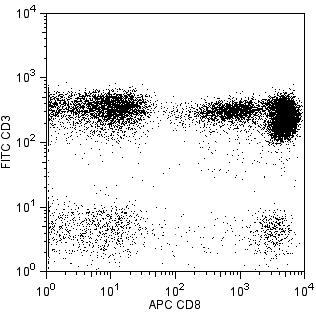
The NHP T/B/NK Cocktail is a three-color reagent cocktail designed to identify NHP T, B, and NK lymphocyte populations by direct immunofluorescent staining with flow cytometric analysis. Clone SP34-2 is a mouse IgG1 isotype monoclonal antibody, descendant of SP34 (mouse IgG3), with the same specificity and reactivity pattern as the parent clone. It cross-reacts with a major subset of peripheral blood lymphocytes, but not monocytes or granulocytes, of baboon, and rhesus, cynomolgus, and pigtail macaque monkeys. The monoclonal antibody clone L27 reacts with CD20 found only on B lymphocytes. The monoclonal antibody clone 3G8 reacts with CD16, the 50-65 kDa transmembrane form of IgG Fc (FcγRIII), a human NK-cell-associated antigen. CD16 is expressed on NK cells as well as macrophages and granulocytes.
Preparation And Storage


Product Notices
- This reagent has been pre-diluted for use at the recommended Volume per Test. We typically use 1 × 10^6 cells in a 100-µl experimental sample (a test).
- Source of all serum proteins is from USDA inspected abattoirs located in the United States.
- Caution: Sodium azide yields highly toxic hydrazoic acid under acidic conditions. Dilute azide compounds in running water before discarding to avoid accumulation of potentially explosive deposits in plumbing.
- For fluorochrome spectra and suitable instrument settings, please refer to our Multicolor Flow Cytometry web page at www.bdbiosciences.com/colors.
- Please refer to www.bdbiosciences.com/us/s/resources for technical protocols.
Companion Products

Development References (7)
-
Barclay NA, Brown MH, Birkeland ML, et al, ed. The Leukocyte Antigen FactsBook. San Diego, CA: Academic Press; 1997.
-
Bleavins MR, Brott DA, Alvey JD, de la Iglesia FA. Flow cytometric characterization of lymphocyte subpopulations in the cynomolgus monkey (Macaca fascicularis). Vet Immunol Immunopathol. 1993; 37(1):1-13. (Biology). View Reference
-
Jacobsen CN, Aasted B, Broe MK, Petersen JL. Reactivities of 20 anti-human monoclonal antibodies with leucocytes from ten different animal species. Vet Immunol Immunopathol. 1993; 39(4):461-466. (Biology). View Reference
-
Knapp W. W. Knapp .. et al., ed. Leucocyte typing IV : white cell differentiation antigens. Oxford New York: Oxford University Press; 1989:1-1182.
-
Schlossman SF. Stuart F. Schlossman .. et al., ed. Leucocyte typing V : white cell differentiation antigens : proceedings of the fifth international workshop and conference held in Boston, USA, 3-7 November, 1993. Oxford: Oxford University Press; 1995.
-
Wilson AD, Shooshtari M, Finerty S, Watkins P, Morgan AJ. Selection of monoclonal antibodies for the identification of lymphocyte surface antigens in the New World primate Saguinus oedipus oedipus (cotton top tamarin). J Immunol Methods. 1995; 178(2):195-200. (Biology). View Reference
-
Wirthmueller U, Kurosaki T, Murakami MS, Ravetch JV. Signal transduction by Fc gamma RIII (CD16) is mediated through the gamma chain. J Exp Med. 1992; 175(5):1381-1390. (Biology). View Reference
Please refer to Support Documents for Quality Certificates
Global - Refer to manufacturer's instructions for use and related User Manuals and Technical data sheets before using this products as described
Comparisons, where applicable, are made against older BD Technology, manual methods or are general performance claims. Comparisons are not made against non-BD technologies, unless otherwise noted.
For Research Use Only. Not for use in diagnostic or therapeutic procedures.
