







Preparation And Storage


Recommended Assay Procedures
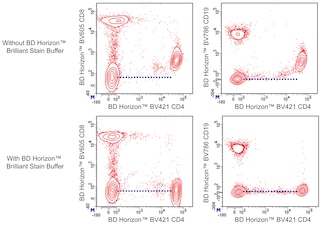
For optimal and reproducible results, BD Horizon Brilliant Stain Buffer should be used anytime two or more BD Horizon Brilliant dyes are used in the same experiment. Fluorescent dye interactions may cause staining artifacts which may affect data interpretation. The BD Horizon Brilliant Stain Buffer was designed to minimize these interactions. More information can be found in the Technical Data Sheet of the BD Horizon Brilliant Stain Buffer (Cat. No. 563794).
Product Notices
- This reagent has been pre-diluted for use at the recommended Volume per Test. We typically use 1 × 10^6 cells in a 100-µl experimental sample (a test).
- An isotype control should be used at the same concentration as the antibody of interest.
- Caution: Sodium azide yields highly toxic hydrazoic acid under acidic conditions. Dilute azide compounds in running water before discarding to avoid accumulation of potentially explosive deposits in plumbing.
- Source of all serum proteins is from USDA inspected abattoirs located in the United States.
- Pacific Blue™ is a trademark of Molecular Probes, Inc., Eugene, OR.
- BD Horizon Brilliant Violet 421 is covered by one or more of the following US patents: 8,158,444; 8,362,193; 8,575,303; 8,354,239.
- BD Horizon Brilliant Stain Buffer is covered by one or more of the following US patents: 8,110,673; 8,158,444; 8,575,303; 8,354,239.
- For fluorochrome spectra and suitable instrument settings, please refer to our Multicolor Flow Cytometry web page at www.bdbiosciences.com/colors.
- Please refer to www.bdbiosciences.com/us/s/resources for technical protocols.
Companion Products
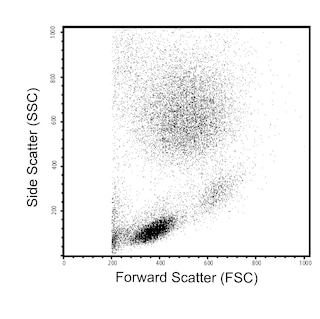

The UP-R1 monoclonal antibody specifically recognizes CD158f which is also known as KIR2DL5. CD158f is a ~60 kDa single-pass type I transmembrane glycoprotein that belongs to the KIR (Killer cell Ig-like receptors) family within the Ig gene superfamily. CD158f is encoded by two gene paralogs, KIR2DL5A and KIR2DL5B that show greater than 99% identity in their coding sequences. CD158f molecules contain two extracellular C2-type Ig-like domains and a long cytoplasmic domain containing one canonical immunoreceptor tyrosine-based inhibitory motif (ITIM) and another atypical ITIM sequence. Although the exact ligands for CD158f have not yet been identified, the inhibitory function of UP-R1 antibody-crosslinked CD158f was shown to primarily depend upon a Src homology region 2-containing protein tyrosine phosphatase-2 (SHP-2) -dependent pathway. CD158f is highly polymorphic and is expressed on subsets of NK cells and T lymphocytes by some individuals. UP-R1 recognizes cell surface CD158f encoded by the most commonly expressed allele, KIR2DL5A*001. The UP-R1 antibody has been predicted to recognize CD158f molecules encoded by other transcriptionally-active KIR2DL5 alleles, A*012 and B*00602.
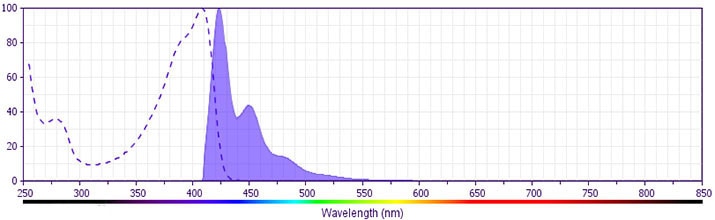
The antibody was conjugated to BD Horizon BV421 which is part of the BD Horizon Brilliant™ Violet family of dyes. With an Ex Max of 407-nm and Em Max at 421-nm, BD Horizon BV421 can be excited by the violet laser and detected in the standard Pacific Blue™ filter set (eg, 450/50-nm filter). BD Horizon BV421 conjugates are very bright, often exhibiting a 10 fold improvement in brightness compared to Pacific Blue conjugates.
Development References (5)
-
Cisneros E, Moraru M, Gómez-Lozano N, López-Botet M, Vilches C. KIR2DL5: An Orphan Inhibitory Receptor Displaying Complex Patterns of Polymorphism and Expression.. Front Immunol. 2012; 3:289. (Clone-specific). View Reference
-
Du Z, Sharma SK, Spellman S, Reed EF, Rajalingam R. KIR2DL5 alleles mark certain combination of activating KIR genes.. Genes Immun. 2008; 9(5):470-80. (Biology). View Reference
-
Estefanía E, Flores R, Gómez-Lozano N, Aguilar H, López-Botet M, Vilches C. Human KIR2DL5 is an inhibitory receptor expressed on the surface of NK and T lymphocyte subsets.. J Immunol. 2007; 178(7):4402-10. (Immunogen: ELISA, Flow cytometry). View Reference
-
Vilches C, Rajalingam R, Uhrberg M, Gardiner CM, Young NT, Parham P. KIR2DL5, a novel killer-cell receptor with a D0-D2 configuration of Ig-like domains.. J Immunol. 2000; 164(11):5797-804. (Biology). View Reference
-
Yusa S, Catina TL, Campbell KS. KIR2DL5 can inhibit human NK cell activation via recruitment of Src homology region 2-containing protein tyrosine phosphatase-2 (SHP-2).. J Immunol. 2004; 172(12):7385-92. (Biology). View Reference
Please refer to Support Documents for Quality Certificates
Global - Refer to manufacturer's instructions for use and related User Manuals and Technical data sheets before using this products as described
Comparisons, where applicable, are made against older BD Technology, manual methods or are general performance claims. Comparisons are not made against non-BD technologies, unless otherwise noted.
For Research Use Only. Not for use in diagnostic or therapeutic procedures.
