







Preparation And Storage


Recommended Assay Procedures
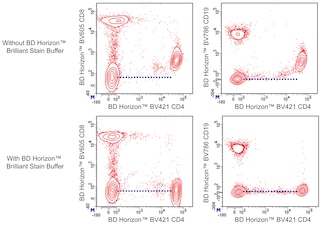
For optimal and reproducible results, BD Horizon Brilliant Stain Buffer should be used anytime two or more BD Horizon Brilliant dyes (including BD OptiBuild Brilliant reagents) are used in the same experiment. Fluorescent dye interactions may cause staining artifacts which may affect data interpretation. The BD Horizon Brilliant Stain Buffer was designed to minimize these interactions. More information can be found in the Technical Data Sheet of the BD Horizon Brilliant Stain Buffer (Cat. No. 563794).
Product Notices
- This antibody was developed for use in flow cytometry.
- The production process underwent stringent testing and validation to assure that it generates a high-quality conjugate with consistent performance and specific binding activity. However, verification testing has not been performed on all conjugate lots.
- Researchers should determine the optimal concentration of this reagent for their individual applications.
- An isotype control should be used at the same concentration as the antibody of interest.
- Caution: Sodium azide yields highly toxic hydrazoic acid under acidic conditions. Dilute azide compounds in running water before discarding to avoid accumulation of potentially explosive deposits in plumbing.
- For fluorochrome spectra and suitable instrument settings, please refer to our Multicolor Flow Cytometry web page at www.bdbiosciences.com/colors.
- Please refer to www.bdbiosciences.com/us/s/resources for technical protocols.
- BD Horizon Brilliant Stain Buffer is covered by one or more of the following US patents: 8,110,673; 8,158,444; 8,575,303; 8,354,239.
- BD Horizon Brilliant Ultraviolet 496 is covered by one or more of the following US patents: 8,110,673; 8,158,444; 8,227,187; 8,575,303; 8,354,239.
Companion Products
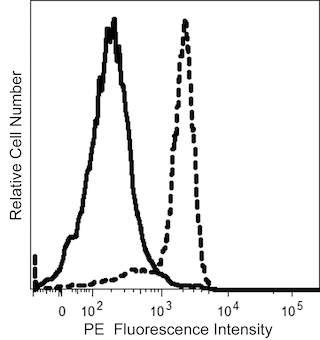
The 2H9 monoclonal antibody specifically binds to the Ephrin Type-B Receptor 2 (EphB2). EphB2 is a type I transmembrane glycoprotein that belongs to the Eph receptor family of tyrosine kinase receptors. EphB2 serves as a cell surface receptor tyrosine kinase for membrane-anchored ligands referred to as type B ephrins (ephrin-B). The EphB2 receptor can bind to ephrin-B1, ephrin-B2, and ephrin-B3. Transmembrane ephrin-B family members are key regulators of embryogenesis including development of the nervous and vascular systems. The EphB2 receptor functions as a chemodirectant in regulating cellular migration. EphB2/ephrin-B interactions orchestrate cell positioning by regulating cellular adhesion and repulsion during development, thereby influencing cell fate, morphogenesis and organogenesis. Signaling can occur in a forward pathway when the EphB2 receptor tyrosine kinase is activated by bound ligand and in a reverse pathway when transmembrane ephrin-B ligands are activated by EphB2 receptor-mediated crosslinking. In the adult body, Eph receptor signaling plays major roles in regulating the architecture and physiology of different tissues under normal as well as disease conditions such as cancer. Ephrin-B1 and ephrin-B2 levels are upregulated in the vasculature during inflammation. Ephrin-B2 molecules that are localized to the luminal endothelial surface can signal through the EphB2 which is expressed by monocytes. This interaction promotes monocyte differentiation into proinflammatory macrophages. In the intestinal epithelium, EphB2/ephrin-B interactions regulate both cell positioning and tumor progression. The differential expression patterns of EphB2 allows for the detection and isolation of various intestinal epithelial cell types. These include intestinal stem cells (ISCs) which express high levels of EphB2. The 2H9 antibody reportedly blocks the interaction of EphB2 with ephrin ligands and crossreacts with mouse EphB2.
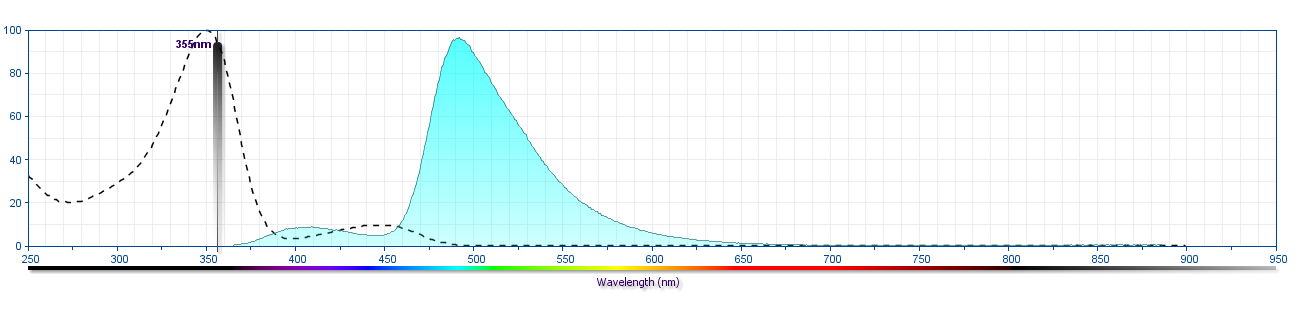
The antibody was conjugated to BD Horizon™ BUV496 which is part of the BD Horizon Brilliant™ Ultraviolet family of dyes. This dye is a tandem fluorochrome of BD Horizon BUV395 with an Ex Max of 348-nm and an acceptor dye with an Em Max at 496-nm. BD Horizon BUV496 can be excited by the ultraviolet laser (355 nm) and detected with a 515/30 nm filter with a 450LP. Due to the excitation of the acceptor dye by other laser lines, there may be significant spillover into the channel detecting BD Horizon V500 or BV510 (eg, 525/40-nm filter). However, the spillover can be corrected through compensation as with any other dye combination.
Development References (6)
-
Foster KE, Gordon J, Cardenas K, et al. EphB-ephrin-B2 interactions are required for thymus migration during organogenesis.. Proc Natl Acad Sci USA. 2010; 107(30):13414-9. (Biology). View Reference
-
Jung P, Sato T, Merlos-Suárez A, et al. Isolation and in vitro expansion of human colonic stem cells. Nat Med. 2011; 17(10):1225-1227. (Biology). View Reference
-
Liu H, Devraj K, Möller K, Liebner S, Hecker M, Korff T. EphrinB-mediated reverse signalling controls junctional integrity and pro-inflammatory differentiation of endothelial cells. Thromb Haemost. 13(112)(Biology). View Reference
-
Mao W, Luis E, Ross S, et al. EphB2 as a therapeutic antibody drug target for the treatment of colorectal cancer. Cancer Res. 204; 64(3):781-788. (Immunogen: Blocking, Cytotoxicity, Depletion, ELISA, Flow cytometry, Fluorescence microscopy, Functional assay, Immunofluorescence, Inhibition, In vivo exacerbation, Neutralization, Radioimmunoassay). View Reference
-
Merlos-Suárez A, Barriga FM, Jung P et al. The intestinal stem cell signature identifies colorectal cancer stem cells and predicts disease relapse. Cell Stem Cell. 2011; 8(5):511-524. (Clone-specific: Flow cytometry). View Reference
-
Pasquale EB. The Eph family of receptors. Curr Opin Cell Biol. 1997; 9(5):608-615. (Biology). View Reference
Please refer to Support Documents for Quality Certificates
Global - Refer to manufacturer's instructions for use and related User Manuals and Technical data sheets before using this products as described
Comparisons, where applicable, are made against older BD Technology, manual methods or are general performance claims. Comparisons are not made against non-BD technologies, unless otherwise noted.
For Research Use Only. Not for use in diagnostic or therapeutic procedures.
