







Preparation And Storage


Recommended Assay Procedures
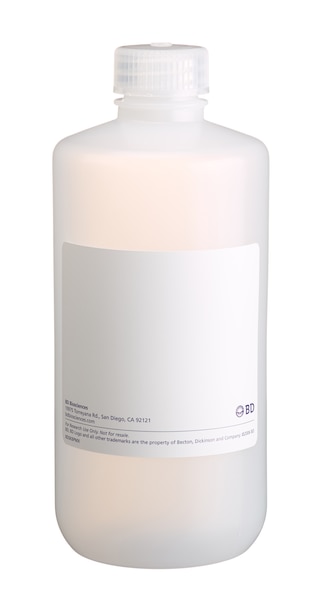
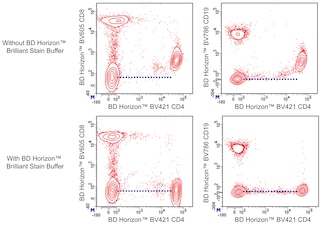
For optimal and reproducible results, BD Horizon Brilliant Stain Buffer should be used anytime two or more BD Horizon Brilliant dyes (including BD OptiBuild Brilliant reagents) are used in the same experiment. Fluorescent dye interactions may cause staining artifacts which may affect data interpretation. The BD Horizon Brilliant Stain Buffer was designed to minimize these interactions. More information can be found in the Technical Data Sheet of the BD Horizon Brilliant Stain Buffer (Cat. No. 563794).
Product Notices
- This antibody was developed for use in flow cytometry.
- The production process underwent stringent testing and validation to assure that it generates a high-quality conjugate with consistent performance and specific binding activity. However, verification testing has not been performed on all conjugate lots.
- Researchers should determine the optimal concentration of this reagent for their individual applications.
- An isotype control should be used at the same concentration as the antibody of interest.
- Caution: Sodium azide yields highly toxic hydrazoic acid under acidic conditions. Dilute azide compounds in running water before discarding to avoid accumulation of potentially explosive deposits in plumbing.
- For fluorochrome spectra and suitable instrument settings, please refer to our Multicolor Flow Cytometry web page at www.bdbiosciences.com/colors.
- Please refer to www.bdbiosciences.com/us/s/resources for technical protocols.
- BD Horizon Brilliant Stain Buffer is covered by one or more of the following US patents: 8,110,673; 8,158,444; 8,575,303; 8,354,239.
- BD Horizon Brilliant Violet 421 is covered by one or more of the following US patents: 8,158,444; 8,362,193; 8,575,303; 8,354,239.
- Pacific Blue™ is a trademark of Molecular Probes, Inc., Eugene, OR.
Companion Products
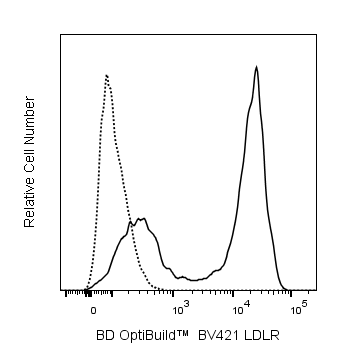
The C7 monoclonal antibody specifically binds to the low-density lipoprotein (LDL) receptor, a type I membrane protein that is encoded by the LDLR gene. LDL is the major cholesterol-carrying lipoprotein in plasma. Cell surface LDLR controls the level of cholesterol in plasma by binding to and internalizing LDL and transporting it to lysosomes where LDL is degraded, cholesterol is released into the cell, and LDLR is recycled back to the cell surface. Hence LDLR is found in cell-surface and intracellular membranes (eg, clathrin-coated pits, golgi, endosomes, and lysosomes). Expression of LDLR is a marker for in vitro differentiation of hepatocytes from human embryonic stem cells. LDLR is suspected to mediate infections by viruses that associate with lipoprotein in the blood. Mutations in LDLR are largely responsible for Familial Hypercholesterolemia (FH). The C7 monoclonal antibody has been reported to react with bovine and human LDLR, but not LDLRs of mouse, rat, Chinese hamster, rabbit or dog.
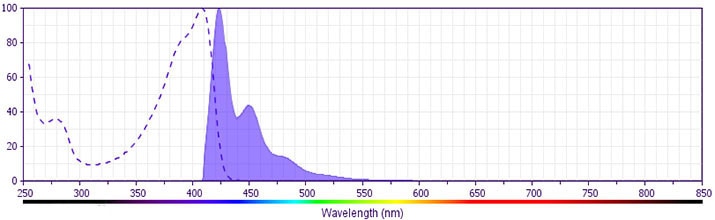
The antibody was conjugated to BD Horizon™ BV421 which is part of the BD Horizon Brilliant™ Violet family of dyes. With an Ex Max of 407-nm and Em Max at 421-nm, BD Horizon BV421 can be excited by the violet laser and detected in the standard Pacific Blue™ filter set (eg, 450/50-nm filter). BD Horizon BV421 conjugates are very bright, often exhibiting a 10 fold improvement in brightness compared to Pacific Blue conjugates.
Development References (6)
-
Beisiegel U, Schneider WJ, Brown MS, Goldstein JL. Immunoblot analysis of low density lipoprotein receptors in fibroblasts from subjects with familial hypercholesterolemia. J Biol Chem. 1982; 257:13150-13156. (Clone-specific: Western blot). View Reference
-
Beisiegel U, Schneider WJ, Goldstein JL, Anderson RG, Brown MS. Monoclonal antibodies to the low density lipoprotein receptor as probes for study of receptor-mediated endocytosis and the genetics of familial hypercholesterolemia. J Biol Chem. 1981; 256(22):11923-11931. (Immunogen). View Reference
-
Francke U, Brown MS, Goldstein JL. Assignment of the human gene for the low density lipoprotein receptor to chromosome 19: synteny of a receptor, a ligand, and a genetic disease. Proc Natl Acad Sci U S A. 1984; 81(9):2826-2830. (Clone-specific: Immunoprecipitation). View Reference
-
Schneider WJ, Beisiegel U, Goldstein JL, Brown MS. Purification of the low density lipoprotein receptor, an acidic glycoprotein of 164,000 molecular weight. J Biol Chem. 1982; 257:2664-26673. (Clone-specific: Immunoaffinity chromatography). View Reference
-
Touboul T, Hannan NR, Corbineau S, et al. Generation of functional hepatocytes from human embryonic stem cells under chemically defined conditions that recapitulate liver development. Hepatology. 2010; 51(5):1754-1765. (Biology). View Reference
-
Yamamoto T, Davis CG, Brown MS, et al. The human LDL receptor: a cysteine-rich protein with multiple Alu sequences in its mRNA. Cell. 1984; 39(1):27-38. (Biology). View Reference
Please refer to Support Documents for Quality Certificates
Global - Refer to manufacturer's instructions for use and related User Manuals and Technical data sheets before using this products as described
Comparisons, where applicable, are made against older BD Technology, manual methods or are general performance claims. Comparisons are not made against non-BD technologies, unless otherwise noted.
For Research Use Only. Not for use in diagnostic or therapeutic procedures.
